

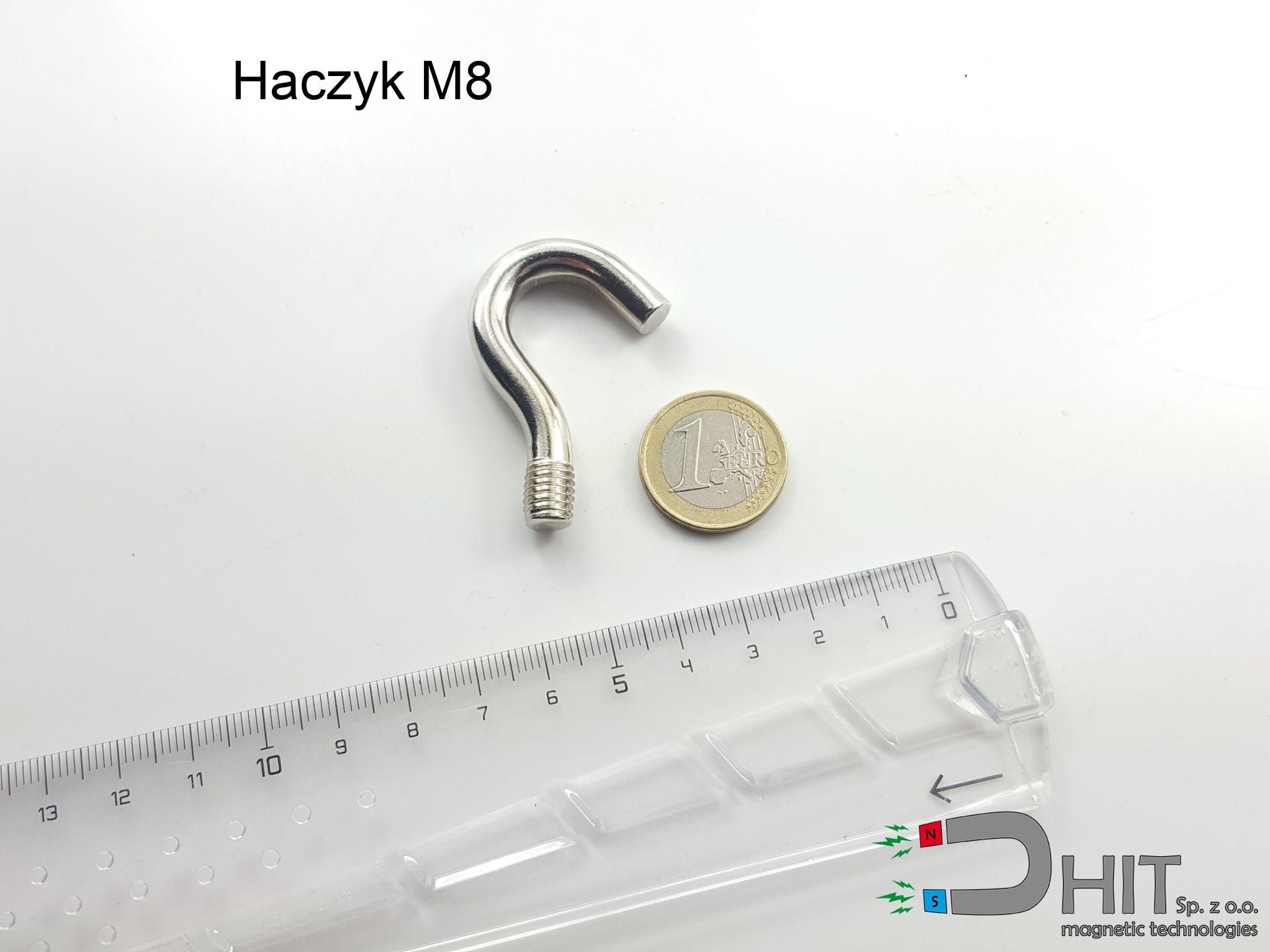
AM Haczyk M8 - magnetic accessories
magnetic accessories
Catalog no 080508
1.000 zł net / pcs
1.230 zł with VAT (23% VAT) / pcs
bulk discounts:
Need more?Frequently asked questions
Where can I find accessories for mounting magnets?
Can I find a technical magnet with a documented pull rating?
Where can I find magnets for a higher operating temperature?
When does an N52 magnet make sense in demanding conditions?
Guides from the knowledge base
Call us now
+48 888 99 98 98
alternatively let us know using
contact form
the contact section.
Specifications and structure of a neodymium magnet can be estimated using our
power calculator.
Order by 14:00 and we’ll ship today!
Product card - AM Haczyk M8 - magnetic accessories
Specification / characteristics - AM Haczyk M8 - magnetic accessories
| properties | values |
|---|---|
| Cat. no. | 080508 |
| Production/Distribution | Dhit sp. z o.o. |
| Country of origin | Poland / China / Germany |
| Customs code | 85059029 |
| Coating | [NiCuNi] Nickel |
| Manufacturing Tolerance | ±1 mm |
Physical properties of sintered neodymium magnets Nd2Fe14B at 20°C
| properties | values | units |
|---|---|---|
| Vickers hardness | ≥550 | Hv |
| Density | ≥7.4 | g/cm3 |
| Curie Temperature TC | 310 | °C |
| Curie Temperature TF | 590 | °F |
| Specific resistance | 150 | μΩ⋅cm |
| Bending strength | 250 | MPa |
| Compressive strength | 1000~1100 | MPa |
| Thermal expansion parallel (∥) to orientation (M) | (3-4) x 10-6 | °C-1 |
| Thermal expansion perpendicular (⊥) to orientation (M) | -(1-3) x 10-6 | °C-1 |
| Young's modulus | 1.7 x 10⁴ | kg/mm² |
Material specification
| iron (Fe) | 64% – 68% |
| neodymium (Nd) | 29% – 32% |
| boron (B) | 1.1% – 1.2% |
| dysprosium (Dy) | 0.5% – 2.0% |
| coating (Ni-Cu-Ni) | < 0.05% |
Environmental data
| recyclability (EoL) | 100% |
| recycled raw materials | ~10% (pre-cons) |
| carbon footprint | low / zredukowany |
| waste code (EWC) | 16 02 16 |
See more deals
![SM 32x275 [2xM8] / N42 - magnetic separator](https://cdn3.dhit.pl/graphics/products/sm-32x275-2xm8-hac.jpg "SM 32x275 [2xM8] / N42 - magnetic separator")
Pros as well as cons of neodymium magnets.
Pros
- They retain magnetic properties for almost 10 years – the loss is just ~1% (based on simulations),
- Neodymium magnets are distinguished by highly resistant to demagnetization caused by external interference,
- In other words, due to the shiny surface of silver, the element looks attractive,
- Magnetic induction on the working layer of the magnet is maximum,
- Thanks to resistance to high temperature, they are able to function (depending on the form) even at temperatures up to 230°C and higher...
- Due to the option of accurate molding and adaptation to unique needs, NdFeB magnets can be manufactured in a broad palette of forms and dimensions, which expands the range of possible applications,
- Huge importance in modern industrial fields – they find application in magnetic memories, electric drive systems, advanced medical instruments, and technologically advanced constructions.
- Thanks to concentrated force, small magnets offer high operating force, in miniature format,
Limitations
- They are prone to damage upon heavy impacts. To avoid cracks, it is worth securing magnets in a protective case. Such protection not only protects the magnet but also increases its resistance to damage
- Heat sensitivity: observe the temperature specified for this product. Overheating may permanently weaken the magnet.
- Due to the susceptibility of magnets to corrosion in a humid environment, we suggest using waterproof magnets made of rubber, plastic or other material immune to moisture, in case of application outdoors
- Due to limitations in creating nuts and complex forms in magnets, we propose using a housing - magnetic mount.
- Health risk to health – tiny shards of magnets are risky, in case of ingestion, which is particularly important in the aspect of protecting the youngest. It is also worth noting that small components of these magnets can disrupt the diagnostic process medical in case of swallowing.
- Higher cost of purchase is a significant factor to consider compared to ceramic magnets, especially in budget applications
Lifting parameters
Maximum holding power of the magnet – what affects it?
- with the contact of a sheet made of special test steel, ensuring maximum field concentration
- with a cross-section minimum 10 mm
- characterized by even structure
- under conditions of ideal adhesion (surface-to-surface)
- during detachment in a direction perpendicular to the mounting surface
- at temperature room level
Determinants of lifting force in real conditions
- Gap (between the magnet and the metal), since even a tiny clearance (e.g. 0.5 mm) results in a decrease in force by up to 50% (this also applies to varnish, rust or debris).
- Angle of force application – highest force is available only during pulling at a 90° angle. The force required to slide of the magnet along the surface is typically many times lower (approx. 1/5 of the lifting capacity).
- Element thickness – to utilize 100% power, the steel must be adequately massive. Thin sheet limits the lifting capacity (the magnet "punches through" it).
- Metal type – not every steel reacts the same. Alloy additives weaken the interaction with the magnet.
- Base smoothness – the smoother and more polished the surface, the larger the contact zone and stronger the hold. Roughness creates an air distance.
- Temperature – temperature increase results in weakening of induction. Check the thermal limit for a given model.
Lifting capacity testing was carried out on a smooth plate of suitable thickness, under a perpendicular pulling force, however under parallel forces the holding force is lower. In addition, even a minimal clearance between the magnet and the plate decreases the holding force.
Safe handling of NdFeB magnets
Magnetic interference
An intense magnetic field disrupts the operation of compasses in phones and GPS navigation. Do not bring magnets close to a smartphone to avoid damaging the sensors.
Beware of splinters
Beware of splinters. Magnets can explode upon uncontrolled impact, launching shards into the air. We recommend safety glasses.
Do not drill into magnets
Dust created during machining of magnets is combustible. Do not drill into magnets without proper cooling and knowledge.
Heat warning
Do not exceed the maximum operating temperature stated in the specifications of the particular product. The limit depends on the material, geometry and operating arrangement; there is no single threshold for all neodymium magnets. Overheating can permanently weaken a magnet.
Caution required
Use magnets with awareness. Their immense force can surprise even experienced users. Stay alert and respect their force.
Physical harm
Large magnets can smash fingers in a fraction of a second. Under no circumstances place your hand betwixt two attracting surfaces.
Sensitization to coating
Allergy Notice: The Ni-Cu-Ni coating consists of nickel. If an allergic reaction occurs, immediately stop working with magnets and wear gloves.
Data carriers
Data protection: Neodymium magnets can damage data carriers and sensitive devices (heart implants, hearing aids, timepieces).
Product not for children
Only for adults. Small elements pose a choking risk, leading to intestinal necrosis. Keep out of reach of children and animals.
Warning for heart patients
Warning for patients: Strong magnetic fields disrupt electronics. Keep minimum 30 cm distance or ask another person to handle the magnets.
Tabela kosztu i czasu dostawy
Płatność przed wysyłką:

GLS kurier
Przesyłka będzie u Ciebie za 2-3 dni
14.99 ZŁ

InPost Paczkomaty 24/7
Przesyłka będzie u Ciebie za 1-2 dni
12.30 ZŁ
Płatność przy odbiorze (pobranie):
GLS kurier
Przesyłka będzie u Ciebie za 1-2 dni
23.00 ZŁ