

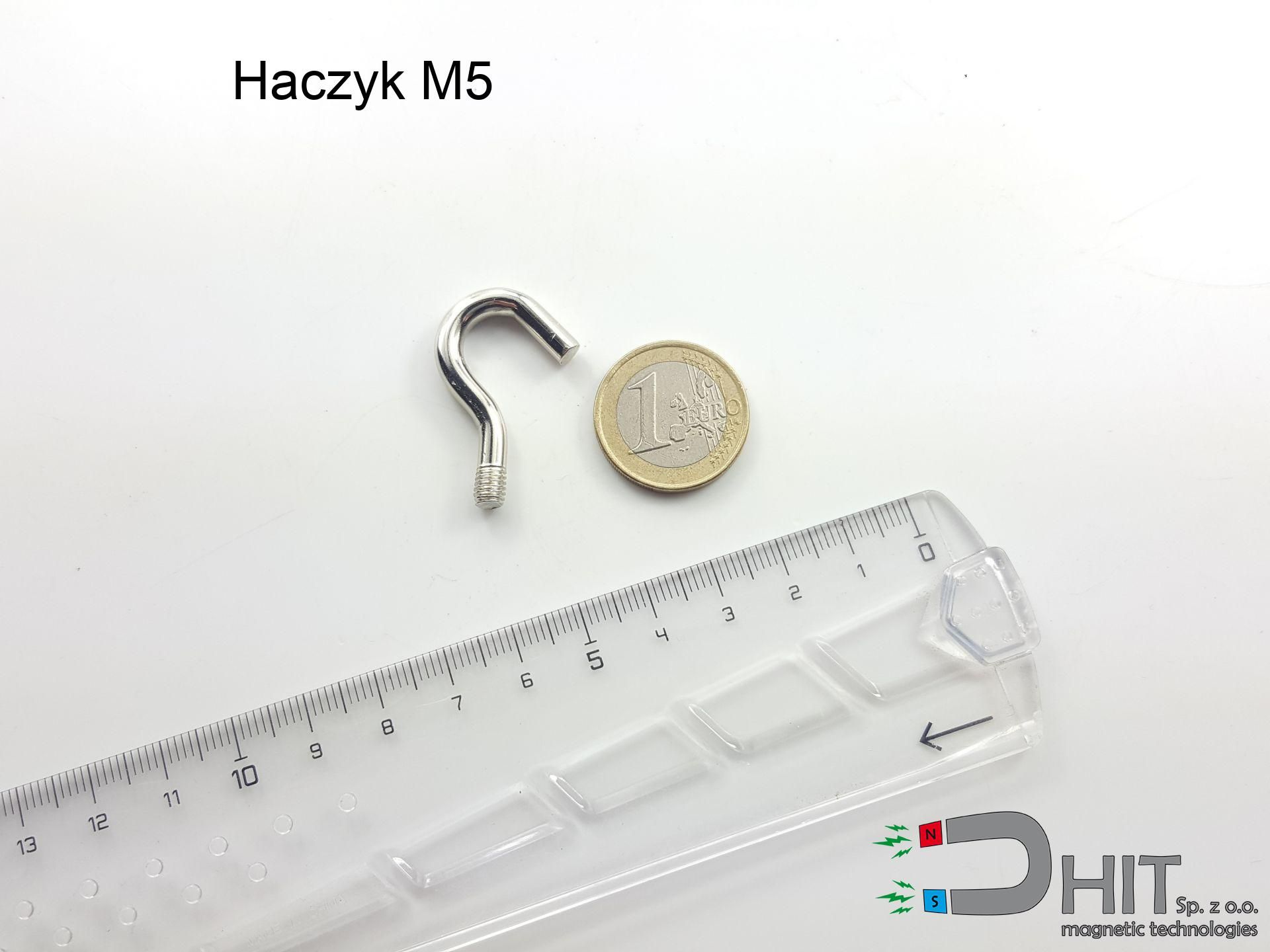
AM Haczyk M5 - magnetic accessories
magnetic accessories
Catalog no 080506
1.000 zł net / pcs
1.230 zł with VAT (23% VAT) / pcs
bulk discounts:
Need more?Frequently asked questions
Where can I find accessories for mounting magnets?
Can I find a technical magnet with a documented pull rating?
Where can I find magnets for a higher operating temperature?
When does an N52 magnet make sense in demanding conditions?
Guides from the knowledge base
Call us now
+48 888 99 98 98
alternatively let us know using
contact form
the contact section.
Specifications and structure of a neodymium magnet can be estimated using our
power calculator.
Order by 14:00 and we’ll ship today!
Technical data of the product - AM Haczyk M5 - magnetic accessories
Specification / characteristics - AM Haczyk M5 - magnetic accessories
| properties | values |
|---|---|
| Cat. no. | 080506 |
| Production/Distribution | Dhit sp. z o.o. |
| Country of origin | Poland / China / Germany |
| Customs code | 85059029 |
| Coating | [NiCuNi] Nickel |
| Manufacturing Tolerance | ±1 mm |
Physical properties of sintered neodymium magnets Nd2Fe14B at 20°C
| properties | values | units |
|---|---|---|
| Vickers hardness | ≥550 | Hv |
| Density | ≥7.4 | g/cm3 |
| Curie Temperature TC | 310 | °C |
| Curie Temperature TF | 590 | °F |
| Specific resistance | 150 | μΩ⋅cm |
| Bending strength | 250 | MPa |
| Compressive strength | 1000~1100 | MPa |
| Thermal expansion parallel (∥) to orientation (M) | (3-4) x 10-6 | °C-1 |
| Thermal expansion perpendicular (⊥) to orientation (M) | -(1-3) x 10-6 | °C-1 |
| Young's modulus | 1.7 x 10⁴ | kg/mm² |
Elemental analysis
| iron (Fe) | 64% – 68% |
| neodymium (Nd) | 29% – 32% |
| boron (B) | 1.1% – 1.2% |
| dysprosium (Dy) | 0.5% – 2.0% |
| coating (Ni-Cu-Ni) | < 0.05% |
Ecology and recycling (GPSR)
| recyclability (EoL) | 100% |
| recycled raw materials | ~10% (pre-cons) |
| carbon footprint | low / zredukowany |
| waste code (EWC) | 16 02 16 |
See also deals
![SM 25x400 [2xM8] / N42 - magnetic separator](https://cdn3.dhit.pl/graphics/products/sm-25x400-2xm8-daj.jpg "SM 25x400 [2xM8] / N42 - magnetic separator")

Advantages as well as disadvantages of neodymium magnets.
Advantages
- They do not lose strength, even over around ten years – the decrease in power is only ~1% (according to tests),
- Neodymium magnets prove to be extremely resistant to loss of magnetic properties caused by external magnetic fields,
- Thanks to the elegant finish, the layer of nickel, gold, or silver gives an elegant appearance,
- Neodymium magnets achieve maximum magnetic induction on a their surface, which allows for strong attraction,
- Thanks to resistance to high temperature, they can operate (depending on the form) even at temperatures up to 230°C and higher...
- Possibility of detailed machining as well as adjusting to defined requirements,
- Significant place in high-tech industry – they are commonly used in hard drives, electric motors, advanced medical instruments, also other advanced devices.
- Thanks to efficiency per cm³, small magnets offer high operating force, in miniature format,
Disadvantages
- Susceptibility to cracking is one of their disadvantages. Upon strong impact they can fracture. We recommend keeping them in a special holder, which not only protects them against impacts but also increases their durability
- Heat sensitivity: observe the temperature specified for this product. Overheating may permanently weaken the magnet.
- Due to the susceptibility of magnets to corrosion in a humid environment, we recommend using waterproof magnets made of rubber, plastic or other material resistant to moisture, when using outdoors
- We recommend casing - magnetic holder, due to difficulties in producing threads inside the magnet and complex shapes.
- Potential hazard resulting from small fragments of magnets pose a threat, when accidentally swallowed, which becomes key in the context of child safety. Furthermore, small components of these products are able to be problematic in diagnostics medical when they are in the body.
- High unit price – neodymium magnets have a higher price than other types of magnets (e.g. ferrite), which hinders application in large quantities
Holding force characteristics
Breakaway strength of the magnet in ideal conditions – what contributes to it?
- with the use of a yoke made of low-carbon steel, guaranteeing maximum field concentration
- whose transverse dimension equals approx. 10 mm
- with an polished touching surface
- without the slightest insulating layer between the magnet and steel
- under vertical force direction (90-degree angle)
- in stable room temperature
Magnet lifting force in use – key factors
- Distance – existence of any layer (paint, tape, air) interrupts the magnetic circuit, which lowers power steeply (even by 50% at 0.5 mm).
- Force direction – declared lifting capacity refers to detachment vertically. When attempting to slide, the magnet exhibits significantly lower power (often approx. 20-30% of maximum force).
- Wall thickness – thin material does not allow full use of the magnet. Part of the magnetic field passes through the material instead of generating force.
- Metal type – different alloys attracts identically. High carbon content worsen the interaction with the magnet.
- Surface finish – ideal contact is obtained only on polished steel. Any scratches and bumps create air cushions, reducing force.
- Thermal conditions – neodymium magnets have a sensitivity to temperature. When it is hot they lose power, and at low temperatures they can be stronger (up to a certain limit).
Holding force was checked on the plate surface of 20 mm thickness, when a perpendicular force was applied, however under parallel forces the load capacity is reduced by as much as 5 times. Moreover, even a minimal clearance between the magnet’s surface and the plate lowers the lifting capacity.
H&S for magnets
Mechanical processing
Combustion risk: Neodymium dust is highly flammable. Avoid machining magnets in home conditions as this may cause fire.
Handling guide
Before use, read the rules. Sudden snapping can destroy the magnet or hurt your hand. Be predictive.
Magnetic interference
Be aware: rare earth magnets generate a field that confuses sensitive sensors. Maintain a safe distance from your mobile, tablet, and GPS.
Danger to pacemakers
Patients with a pacemaker should keep an absolute distance from magnets. The magnetic field can stop the functioning of the life-saving device.
Magnets are brittle
NdFeB magnets are sintered ceramics, meaning they are fragile like glass. Clashing of two magnets leads to them breaking into small pieces.
Permanent damage
Do not exceed the maximum operating temperature stated in the specifications of the particular product. The limit depends on the material, geometry and operating arrangement; there is no single threshold for all neodymium magnets. Overheating can permanently weaken a magnet.
Cards and drives
Avoid bringing magnets near a purse, computer, or TV. The magnetism can irreversibly ruin these devices and erase data from cards.
This is not a toy
Strictly keep magnets away from children. Ingestion danger is high, and the consequences of magnets clamping inside the body are very dangerous.
Metal Allergy
Certain individuals experience a sensitization to nickel, which is the standard coating for neodymium magnets. Prolonged contact can result in dermatitis. We recommend use safety gloves.
Crushing risk
Risk of injury: The pulling power is so great that it can cause blood blisters, pinching, and even bone fractures. Protective gloves are recommended.
Tabela kosztu i czasu dostawy
Płatność przed wysyłką:

GLS kurier
Przesyłka będzie u Ciebie za 2-3 dni
14.99 ZŁ

InPost Paczkomaty 24/7
Przesyłka będzie u Ciebie za 1-2 dni
12.30 ZŁ
Płatność przy odbiorze (pobranie):
GLS kurier
Przesyłka będzie u Ciebie za 1-2 dni
23.00 ZŁ