

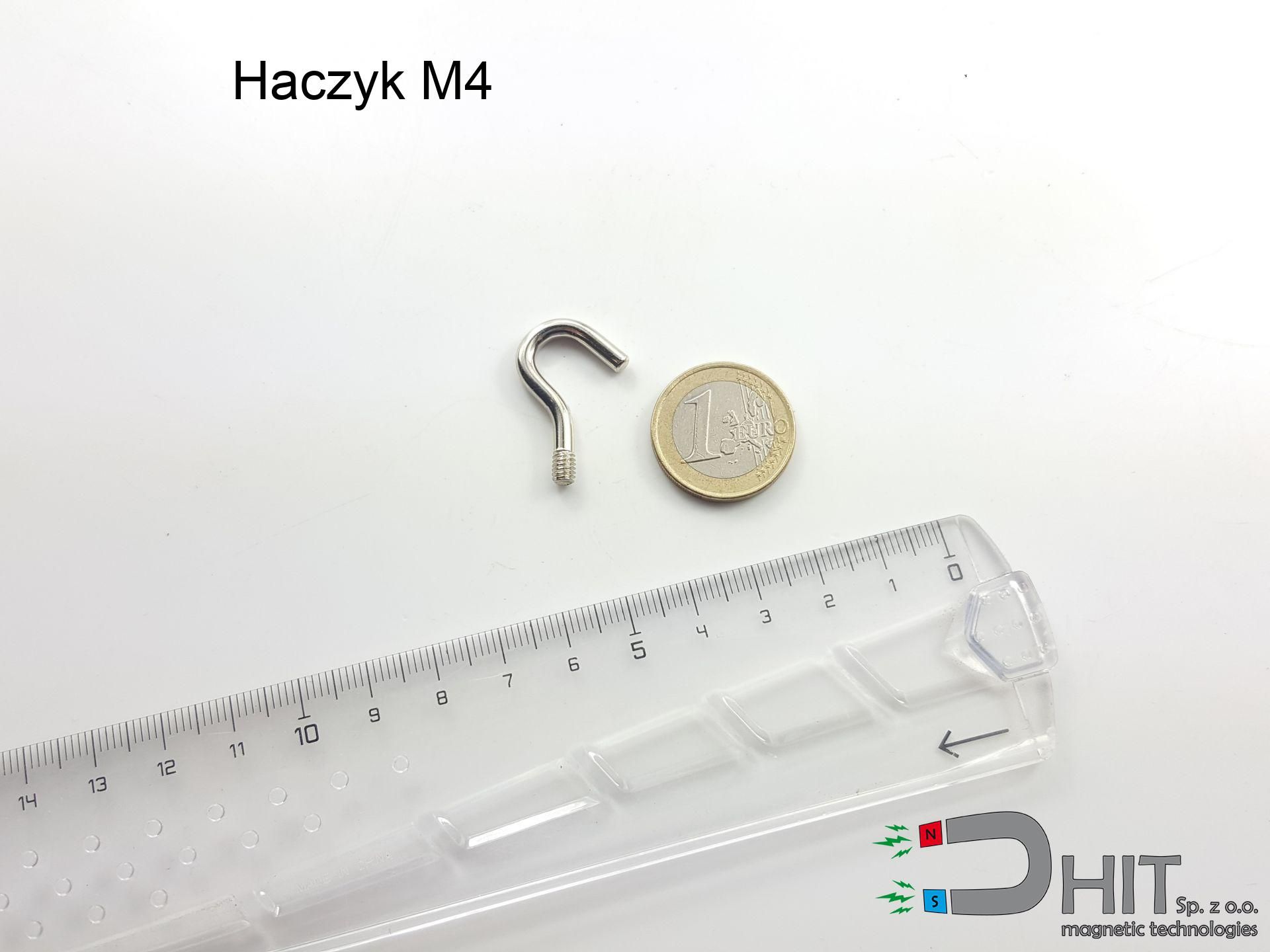
AM Haczyk M4 - magnetic accessories
magnetic accessories
Catalog no 080505
1.000 zł net / pcs
1.230 zł with VAT (23% VAT) / pcs
bulk discounts:
Need more?Frequently asked questions
Where can I find accessories for mounting magnets?
Can I find a technical magnet with a documented pull rating?
Where can I find magnets for a higher operating temperature?
When does an N52 magnet make sense in demanding conditions?
Guides from the knowledge base
Call us now
+48 888 99 98 98
alternatively let us know using
contact form
the contact section.
Specifications and structure of a neodymium magnet can be estimated using our
power calculator.
Order by 14:00 and we’ll ship today!
Technical - AM Haczyk M4 - magnetic accessories
Specification / characteristics - AM Haczyk M4 - magnetic accessories
| properties | values |
|---|---|
| Cat. no. | 080505 |
| Production/Distribution | Dhit sp. z o.o. |
| Country of origin | Poland / China / Germany |
| Customs code | 85059029 |
| Coating | [NiCuNi] Nickel |
| Manufacturing Tolerance | ±1 mm |
Physical properties of sintered neodymium magnets Nd2Fe14B at 20°C
| properties | values | units |
|---|---|---|
| Vickers hardness | ≥550 | Hv |
| Density | ≥7.4 | g/cm3 |
| Curie Temperature TC | 310 | °C |
| Curie Temperature TF | 590 | °F |
| Specific resistance | 150 | μΩ⋅cm |
| Bending strength | 250 | MPa |
| Compressive strength | 1000~1100 | MPa |
| Thermal expansion parallel (∥) to orientation (M) | (3-4) x 10-6 | °C-1 |
| Thermal expansion perpendicular (⊥) to orientation (M) | -(1-3) x 10-6 | °C-1 |
| Young's modulus | 1.7 x 10⁴ | kg/mm² |
Elemental analysis
| iron (Fe) | 64% – 68% |
| neodymium (Nd) | 29% – 32% |
| boron (B) | 1.1% – 1.2% |
| dysprosium (Dy) | 0.5% – 2.0% |
| coating (Ni-Cu-Ni) | < 0.05% |
Sustainability
| recyclability (EoL) | 100% |
| recycled raw materials | ~10% (pre-cons) |
| carbon footprint | low / zredukowany |
| waste code (EWC) | 16 02 16 |
Other proposals
![UMGGW 66x8.5 [M8] GW / N38 - magnetic holder rubber internal thread](https://cdn3.dhit.pl/graphics/products/umg-66x8.5-m6-gw-wud.jpg "UMGGW 66x8.5 [M8] GW / N38 - magnetic holder rubber internal thread")
![SM 32x300 [2xM8] / N52 - magnetic separator](https://cdn3.dhit.pl/graphics/products/sm-32x300-2xm8-luf.jpg "SM 32x300 [2xM8] / N52 - magnetic separator")
Pros and cons of rare earth magnets.
Pros
- They retain full power for around 10 years – the drop is just ~1% (based on simulations),
- They feature excellent resistance to magnetism drop as a result of external fields,
- By applying a decorative coating of nickel, the element has an aesthetic look,
- The surface of neodymium magnets generates a unique magnetic field – this is one of their assets,
- Made from properly selected components, these magnets show impressive resistance to high heat, enabling them to function (depending on their shape) at temperatures up to 230°C and above...
- Possibility of precise shaping and adjusting to specific needs,
- Huge importance in innovative solutions – they are commonly used in computer drives, drive modules, advanced medical instruments, also multitasking production systems.
- Relatively small size with high pulling force – neodymium magnets offer strong magnetic field in tiny dimensions, which allows their use in compact constructions
Weaknesses
- At very strong impacts they can break, therefore we advise placing them in steel cases. A metal housing provides additional protection against damage, as well as increases the magnet's durability.
- Heat sensitivity: observe the temperature specified for this product. Overheating may permanently weaken the magnet.
- They rust in a humid environment - during use outdoors we suggest using waterproof magnets e.g. in rubber, plastic
- We recommend a housing - magnetic holder, due to difficulties in producing threads inside the magnet and complex shapes.
- Potential hazard resulting from small fragments of magnets are risky, if swallowed, which is particularly important in the aspect of protecting the youngest. Additionally, small components of these products are able to complicate diagnosis medical in case of swallowing.
- Higher cost of purchase is a significant factor to consider compared to ceramic magnets, especially in budget applications
Lifting parameters
Magnetic strength at its maximum – what it depends on?
- with the use of a yoke made of special test steel, ensuring full magnetic saturation
- whose thickness reaches at least 10 mm
- characterized by even structure
- with total lack of distance (without coatings)
- during detachment in a direction vertical to the plane
- in temp. approx. 20°C
Practical aspects of lifting capacity – factors
- Air gap (between the magnet and the plate), since even a tiny distance (e.g. 0.5 mm) leads to a decrease in lifting capacity by up to 50% (this also applies to paint, rust or dirt).
- Pull-off angle – remember that the magnet holds strongest perpendicularly. Under shear forces, the holding force drops drastically, often to levels of 20-30% of the nominal value.
- Steel thickness – too thin steel does not accept the full field, causing part of the flux to be lost to the other side.
- Metal type – not every steel reacts the same. High carbon content worsen the interaction with the magnet.
- Surface condition – ground elements ensure maximum contact, which improves field saturation. Uneven metal weaken the grip.
- Temperature – heating the magnet causes a temporary drop of induction. It is worth remembering the thermal limit for a given model.
Lifting capacity testing was conducted on a smooth plate of optimal thickness, under perpendicular forces, however under parallel forces the lifting capacity is smaller. In addition, even a slight gap between the magnet and the plate decreases the holding force.
Safety rules for work with NdFeB magnets
Life threat
For implant holders: Strong magnetic fields disrupt medical devices. Keep at least 30 cm distance or ask another person to work with the magnets.
Heat sensitivity
Do not exceed the maximum operating temperature stated in the specifications of the particular product. The limit depends on the material, geometry and operating arrangement; there is no single threshold for all neodymium magnets. Overheating can permanently weaken a magnet.
Threat to electronics
Equipment safety: Neodymium magnets can damage data carriers and sensitive devices (pacemakers, medical aids, timepieces).
Product not for children
NdFeB magnets are not suitable for play. Swallowing multiple magnets can lead to them connecting inside the digestive tract, which poses a critical condition and necessitates immediate surgery.
Dust explosion hazard
Machining of neodymium magnets carries a risk of fire risk. Magnetic powder reacts violently with oxygen and is hard to extinguish.
Immense force
Be careful. Rare earth magnets attract from a distance and snap with huge force, often faster than you can react.
Nickel coating and allergies
Some people experience a contact allergy to Ni, which is the standard coating for NdFeB magnets. Extended handling may cause a rash. It is best to use protective gloves.
Compass and GPS
Remember: neodymium magnets produce a field that disrupts sensitive sensors. Maintain a safe distance from your phone, tablet, and navigation systems.
Crushing risk
Big blocks can crush fingers instantly. Do not place your hand betwixt two strong magnets.
Shattering risk
NdFeB magnets are sintered ceramics, which means they are prone to chipping. Impact of two magnets will cause them cracking into shards.
Tabela kosztu i czasu dostawy
Płatność przed wysyłką:

GLS kurier
Przesyłka będzie u Ciebie za 2-3 dni
14.99 ZŁ

InPost Paczkomaty 24/7
Przesyłka będzie u Ciebie za 1-2 dni
12.30 ZŁ
Płatność przy odbiorze (pobranie):
GLS kurier
Przesyłka będzie u Ciebie za 1-2 dni
23.00 ZŁ