
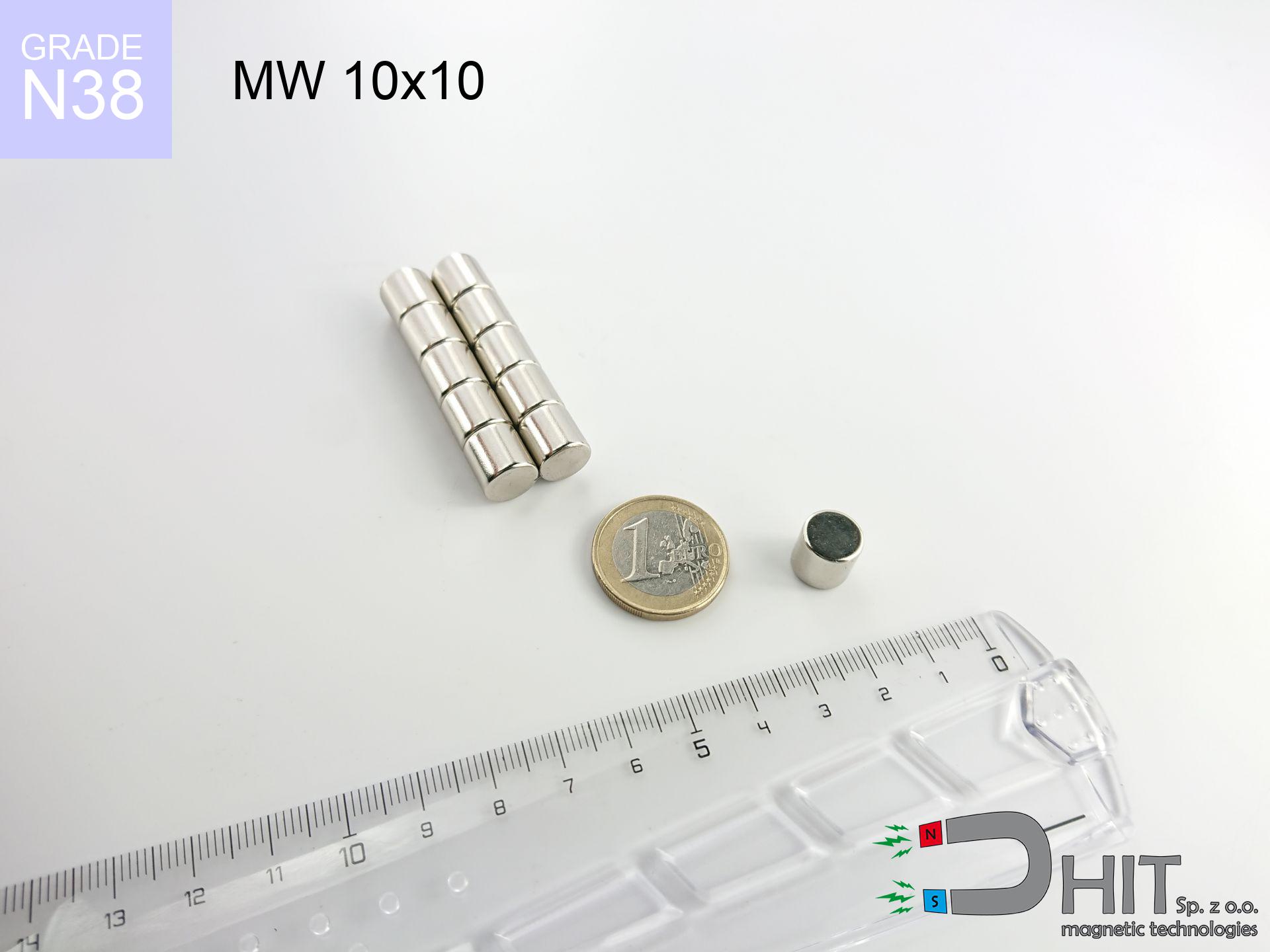
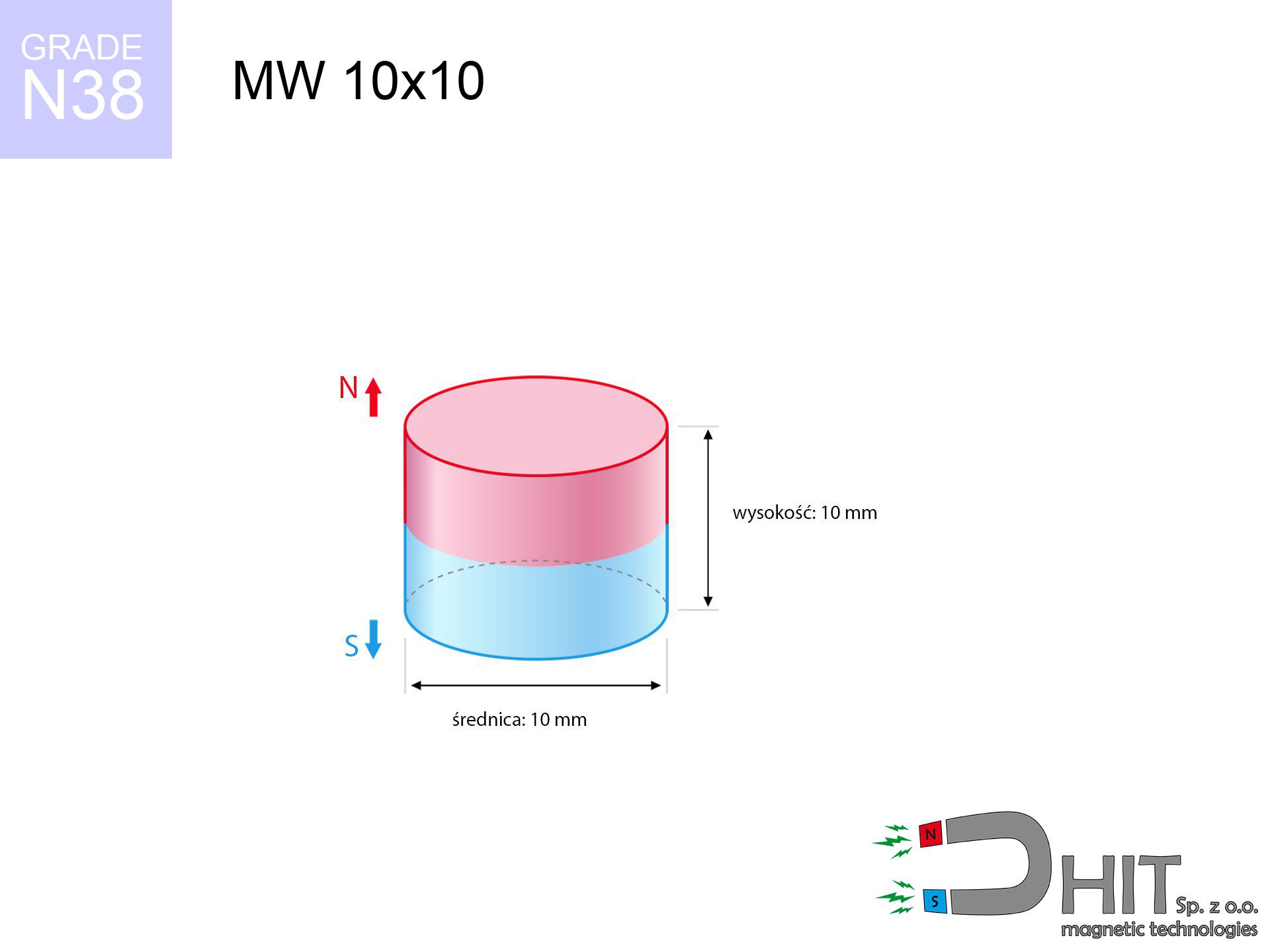
MW 10x10 / N38 - cylindrical magnet
cylindrical magnet
Catalog no 010004
GTIN: 5906301810032
Diameter Ø [±0,1 mm]
10 mm
Height [±0,1 mm]
10 mm
Weight
5.89 g
Magnetization Direction
↑ axial
Load capacity
5.53 kg / 54.23 N
Magnetic Induction
553.84 mT
Coating
[NiCuNi] nickel
4.31 ZŁ with VAT / pcs + price for transport
3.50 ZŁ net + 23% VAT / pcs
2.57 ZŁ net was the lowest price in the last 30 days
bulk discounts:
Need more?Not sure about your choice?
Pick up the phone and ask
+48 22 499 98 98
otherwise contact us using
request form
the contact form page.
Weight and form of magnetic components can be estimated using our
power calculator.
Orders submitted before 14:00 will be dispatched today!
Magnetic properties of material N38
Physical properties of sintered neodymium magnets Nd2Fe14B at 20°C
Shopping tips

![UMGW 75x33x18 [M10] GW / N38 - magnetic holder internal thread](https://cdn3.dhit.pl/graphics/products/umgw-75x33x18-m10-gw-cak.jpg "UMGW 75x33x18 [M10] GW / N38 - magnetic holder internal thread")
![SM 32x325 [2xM8] / N42 - magnetic separator](https://cdn3.dhit.pl/graphics/products/sm-32x325-2xm8-fog.jpg "SM 32x325 [2xM8] / N42 - magnetic separator")
Pros as well as cons of rare earth magnets.
Besides their remarkable field intensity, neodymium magnets offer the following advantages:
- They retain magnetic properties for nearly ten years – the loss is just ~1% (according to analyses),
- Neodymium magnets are characterized by exceptionally resistant to demagnetization caused by magnetic disturbances,
- A magnet with a metallic gold surface is more attractive,
- Magnets are distinguished by very high magnetic induction on the surface,
- Through (adequate) combination of ingredients, they can achieve high thermal resistance, enabling functioning at temperatures approaching 230°C and above...
- Possibility of precise shaping as well as modifying to concrete conditions,
- Versatile presence in future technologies – they are utilized in HDD drives, drive modules, advanced medical instruments, and complex engineering applications.
- Compactness – despite small sizes they provide effective action, making them ideal for precision applications
Disadvantages of neodymium magnets:
- Brittleness is one of their disadvantages. Upon intense impact they can fracture. We advise keeping them in a steel housing, which not only secures them against impacts but also raises their durability
- We warn that neodymium magnets can reduce their power at high temperatures. To prevent this, we recommend our specialized [AH] magnets, which work effectively even at 230°C.
- Due to the susceptibility of magnets to corrosion in a humid environment, we suggest using waterproof magnets made of rubber, plastic or other material resistant to moisture, when using outdoors
- Due to limitations in producing nuts and complex shapes in magnets, we propose using a housing - magnetic mechanism.
- Potential hazard related to microscopic parts of magnets pose a threat, if swallowed, which is particularly important in the context of child safety. Additionally, tiny parts of these devices are able to be problematic in diagnostics medical after entering the body.
- High unit price – neodymium magnets have a higher price than other types of magnets (e.g. ferrite), which can limit application in large quantities
Detachment force of the magnet in optimal conditions – what contributes to it?
Breakaway force is the result of a measurement for ideal contact conditions, assuming:
- with the application of a sheet made of special test steel, ensuring full magnetic saturation
- possessing a massiveness of min. 10 mm to avoid saturation
- with an ideally smooth contact surface
- without any clearance between the magnet and steel
- for force applied at a right angle (in the magnet axis)
- at conditions approx. 20°C
Impact of factors on magnetic holding capacity in practice
Effective lifting capacity impacted by specific conditions, including (from priority):
- Space between surfaces – every millimeter of separation (caused e.g. by varnish or dirt) drastically reduces the magnet efficiency, often by half at just 0.5 mm.
- Pull-off angle – note that the magnet has greatest strength perpendicularly. Under sliding down, the holding force drops drastically, often to levels of 20-30% of the maximum value.
- Element thickness – for full efficiency, the steel must be adequately massive. Thin sheet limits the lifting capacity (the magnet "punches through" it).
- Material composition – not every steel reacts the same. Alloy additives worsen the attraction effect.
- Surface finish – full contact is possible only on smooth steel. Any scratches and bumps create air cushions, reducing force.
- Thermal conditions – neodymium magnets have a sensitivity to temperature. When it is hot they are weaker, and in frost they can be stronger (up to a certain limit).
* Holding force was measured on a smooth steel plate of 20 mm thickness, when the force acted perpendicularly, however under attempts to slide the magnet the lifting capacity is smaller. In addition, even a minimal clearance {between} the magnet and the plate decreases the lifting capacity.
Precautions when working with NdFeB magnets
Heat warning
Regular neodymium magnets (grade N) undergo demagnetization when the temperature goes above 80°C. Damage is permanent.
Handling rules
Be careful. Neodymium magnets act from a distance and snap with massive power, often faster than you can react.
Physical harm
Mind your fingers. Two powerful magnets will snap together immediately with a force of massive weight, crushing anything in their path. Exercise extreme caution!
Do not drill into magnets
Powder generated during cutting of magnets is self-igniting. Do not drill into magnets without proper cooling and knowledge.
Skin irritation risks
Medical facts indicate that the nickel plating (standard magnet coating) is a common allergen. If your skin reacts to metals, prevent touching magnets with bare hands and opt for versions in plastic housing.
Keep away from electronics
GPS units and mobile phones are highly sensitive to magnetism. Direct contact with a strong magnet can permanently damage the sensors in your phone.
Protect data
Intense magnetic fields can destroy records on credit cards, HDDs, and other magnetic media. Keep a distance of at least 10 cm.
Life threat
For implant holders: Strong magnetic fields disrupt electronics. Maintain minimum 30 cm distance or ask another person to handle the magnets.
Choking Hazard
Absolutely store magnets out of reach of children. Choking hazard is high, and the effects of magnets clamping inside the body are life-threatening.
Material brittleness
Despite metallic appearance, the material is delicate and not impact-resistant. Do not hit, as the magnet may shatter into sharp, dangerous pieces.
Danger!
Learn more about hazards in the article: Magnet Safety Guide.
Tabela kosztu i czasu dostawy
Płatność przed wysyłką:

GLS kurier
Przesyłka będzie u Ciebie za 2-3 dni
14.99 ZŁ

InPost Paczkomaty 24/7
Przesyłka będzie u Ciebie za 1-2 dni
12.30 ZŁ
Płatność przy odbiorze (pobranie):
GLS kurier
Przesyłka będzie u Ciebie za 1-2 dni
23.00 ZŁ
Rate the product

Your rating