

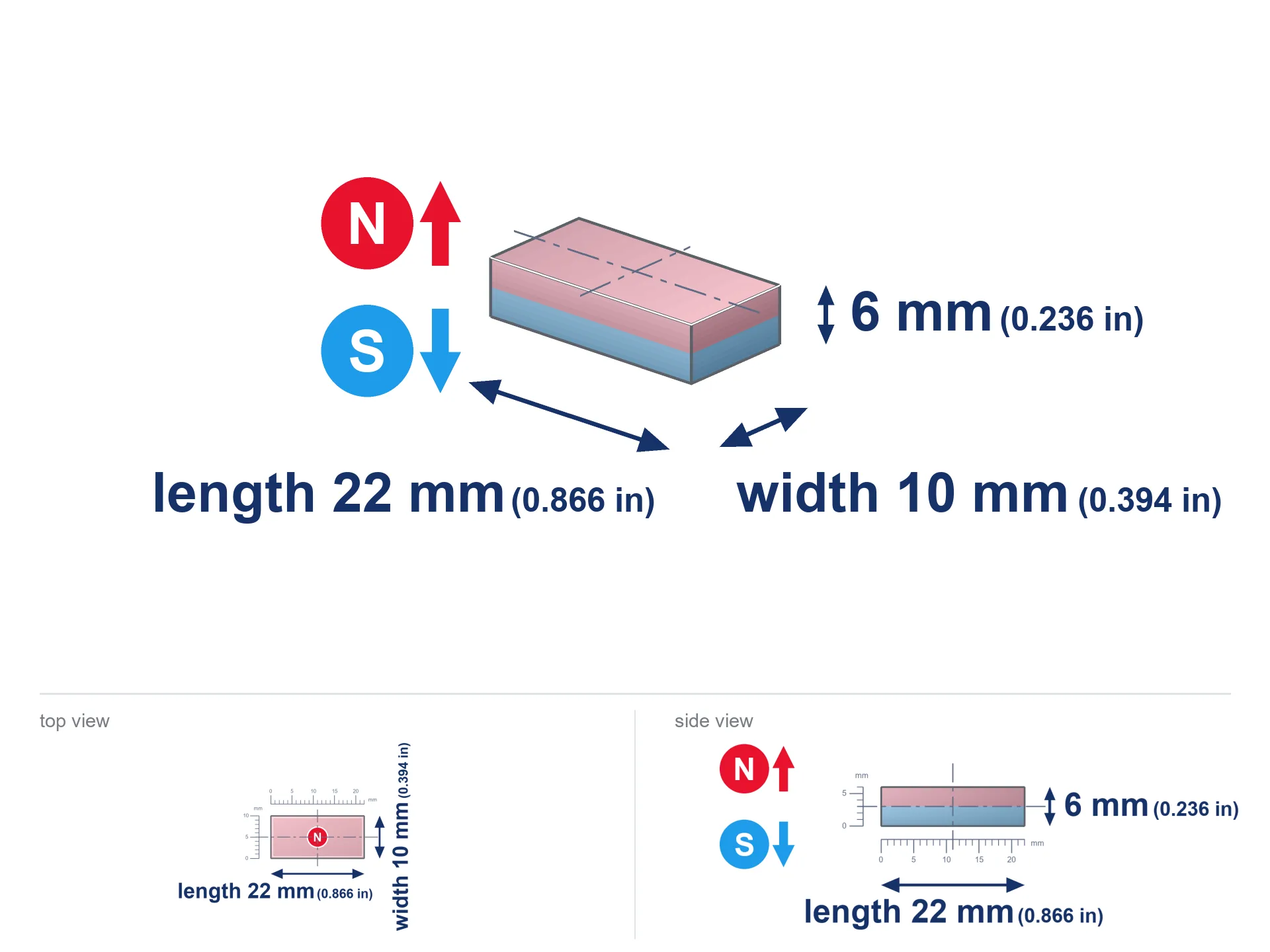
MPL 22x10x6 / N38 - lamellar magnet
lamellar magnet
Catalog no 020590
GTIN/EAN: 5906301815839
- length
- 22 mm [±0,1 mm]
- Width
- 10 mm [±0,1 mm]
- Height
- 6 mm [±0,1 mm]
- Weight
- 9.9 g
- Magnetization Direction
- ↑ axial
- Coating
- [NiCuNi] Nickel
How we measure these parameters — certificates and measurements
4.71 zł net / pcs
5.79 zł with VAT (23% VAT) / pcs
bulk discounts:
Need more?Frequently asked questions
What pull rating should I choose for a workshop block magnet?
Are block neodymium magnets available in more durable versions?
How should I choose block magnets for mounting a structure?
Engineering report for this magnet
Full PDF analysis: pull and shear force, effect of distance, temperature and plate thickness, safety distances and the demagnetization curve.
Call us now
+48 888 99 98 98
alternatively let us know using
contact form
the contact section.
Specifications and structure of a neodymium magnet can be estimated using our
power calculator.
Order by 14:00 and we’ll ship today!
Detailed specification - MPL 22x10x6 / N38 - lamellar magnet
Specification / characteristics - MPL 22x10x6 / N38 - lamellar magnet
| properties | values |
|---|---|
| Cat. no. | 020590 |
| GTIN/EAN | 5906301815839 |
| Distributor | Dhit sp. z o.o. |
| Country of origin | Poland / China / Germany |
| Customs code | 85059029 |
| length | 22 mm [±0,1 mm] |
| Width | 10 mm [±0,1 mm] |
| Height | 6 mm [±0,1 mm] |
| Weight | 9.9 g |
| Magnetization Direction | ↑ axial |
| Load capacity ~ ? | 7.15 kg / 70.12 N |
| Magnetic Induction ~ ? | 384.12 mT / 3841 Gs |
| Coating | [NiCuNi] Nickel |
| Manufacturing Tolerance | ±0.1 mm |
Magnetic properties of material N38
| properties | values | units |
|---|---|---|
| Remanence Br ? | 12.2-12.6 | kGs |
| Remanence Br ? | 1220-1260 | mT |
| Coercivity bHc ? | 10.8-11.5 | kOe |
| Coercivity bHc ? | 860-915 | kA/m |
| Intrinsic coercivity iHc | ≥ 12 | kOe |
| Intrinsic coercivity iHc | ≥ 955 | kA/m |
| Energy product BHmax ? | 36-38 | BH max MGOe |
| Energy product BHmax ? | 287-303 | BH max KJ/m |
| Maximum working temperature ? | ≤ 80 | °C |
Physical properties of sintered neodymium magnets Nd2Fe14B at 20°C
| properties | values | units |
|---|---|---|
| Vickers hardness | ≥550 | Hv |
| Density | ≥7.4 | g/cm3 |
| Curie Temperature TC | 310 | °C |
| Curie Temperature TF | 590 | °F |
| Specific resistance | 150 | μΩ⋅cm |
| Bending strength | 250 | MPa |
| Compressive strength | 1000~1100 | MPa |
| Thermal expansion parallel (∥) to orientation (M) | (3-4) x 10-6 | °C-1 |
| Thermal expansion perpendicular (⊥) to orientation (M) | -(1-3) x 10-6 | °C-1 |
| Young's modulus | 1.7 x 10⁴ | kg/mm² |
Engineering simulation of the magnet - report
These values are the direct effect of a physical simulation. Values were calculated on algorithms for the material Nd2Fe14B. Actual parameters might slightly differ. Please consider these calculations as a preliminary roadmap during assembly planning.
Table 1: Static force (force vs gap) - power drop
MPL 22x10x6 / N38
| Distance (mm) | Induction (Gauss) / mT | Pull Force (kg/lbs/g/N) | Risk Status |
|---|---|---|---|
| 0 mm |
3839 Gs
383.9 mT
|
7.15 kg / 15.76 lbs
7150.0 g / 70.1 N
|
medium risk |
| 1 mm |
3321 Gs
332.1 mT
|
5.35 kg / 11.79 lbs
5348.8 g / 52.5 N
|
medium risk |
| 2 mm |
2798 Gs
279.8 mT
|
3.80 kg / 8.37 lbs
3796.9 g / 37.2 N
|
medium risk |
| 3 mm |
2324 Gs
232.4 mT
|
2.62 kg / 5.78 lbs
2620.9 g / 25.7 N
|
medium risk |
| 5 mm |
1588 Gs
158.8 mT
|
1.22 kg / 2.70 lbs
1223.7 g / 12.0 N
|
weak grip |
| 10 mm |
661 Gs
66.1 mT
|
0.21 kg / 0.47 lbs
211.9 g / 2.1 N
|
weak grip |
| 15 mm |
317 Gs
31.7 mT
|
0.05 kg / 0.11 lbs
48.9 g / 0.5 N
|
weak grip |
| 20 mm |
172 Gs
17.2 mT
|
0.01 kg / 0.03 lbs
14.3 g / 0.1 N
|
weak grip |
| 30 mm |
65 Gs
6.5 mT
|
0.00 kg / 0.00 lbs
2.0 g / 0.0 N
|
weak grip |
| 50 mm |
17 Gs
1.7 mT
|
0.00 kg / 0.00 lbs
0.1 g / 0.0 N
|
weak grip |
Table 2: Vertical capacity (wall)
MPL 22x10x6 / N38
| Distance (mm) | Friction coefficient | Pull Force (kg/lbs/g/N) |
|---|---|---|
| 0 mm | Raw steel (µ ≈ 0.2) |
1.43 kg / 3.15 lbs
1430.0 g / 14.0 N
|
| 1 mm | Raw steel (µ ≈ 0.2) |
1.07 kg / 2.36 lbs
1070.0 g / 10.5 N
|
| 2 mm | Raw steel (µ ≈ 0.2) |
0.76 kg / 1.68 lbs
760.0 g / 7.5 N
|
| 3 mm | Raw steel (µ ≈ 0.2) |
0.52 kg / 1.16 lbs
524.0 g / 5.1 N
|
| 5 mm | Raw steel (µ ≈ 0.2) |
0.24 kg / 0.54 lbs
244.0 g / 2.4 N
|
| 10 mm | Raw steel (µ ≈ 0.2) |
0.04 kg / 0.09 lbs
42.0 g / 0.4 N
|
| 15 mm | Raw steel (µ ≈ 0.2) |
0.01 kg / 0.02 lbs
10.0 g / 0.1 N
|
| 20 mm | Raw steel (µ ≈ 0.2) |
0.00 kg / 0.00 lbs
2.0 g / 0.0 N
|
| 30 mm | Raw steel (µ ≈ 0.2) |
0.00 kg / 0.00 lbs
0.0 g / 0.0 N
|
| 50 mm | Raw steel (µ ≈ 0.2) |
0.00 kg / 0.00 lbs
0.0 g / 0.0 N
|
Table 3: Vertical assembly (sliding) - behavior on slippery surfaces
MPL 22x10x6 / N38
| Surface type | Friction coefficient / % | Max load (kg/lbs/g/N) |
|---|---|---|
| Raw steel |
µ = 0.3
30% of nominal force
|
2.15 kg / 4.73 lbs
2145.0 g / 21.0 N
|
| Painted steel (standard) |
µ = 0.2
20% of nominal force
|
1.43 kg / 3.15 lbs
1430.0 g / 14.0 N
|
| Oily/slippery steel |
µ = 0.1
10% of nominal force
|
0.72 kg / 1.58 lbs
715.0 g / 7.0 N
|
| Magnet with anti-slip rubber |
µ = 0.5
50% of nominal force
|
3.58 kg / 7.88 lbs
3575.0 g / 35.1 N
|
Table 4: Material efficiency (substrate influence) - sheet metal selection
MPL 22x10x6 / N38
| Steel thickness (mm) | % power | Real pull force (kg/lbs/g/N) |
|---|---|---|
| 0.5 mm |
|
0.72 kg / 1.58 lbs
715.0 g / 7.0 N
|
| 1 mm |
|
1.79 kg / 3.94 lbs
1787.5 g / 17.5 N
|
| 2 mm |
|
3.58 kg / 7.88 lbs
3575.0 g / 35.1 N
|
| 3 mm |
|
5.36 kg / 11.82 lbs
5362.5 g / 52.6 N
|
| 5 mm |
|
7.15 kg / 15.76 lbs
7150.0 g / 70.1 N
|
| 10 mm |
|
7.15 kg / 15.76 lbs
7150.0 g / 70.1 N
|
| 11 mm |
|
7.15 kg / 15.76 lbs
7150.0 g / 70.1 N
|
| 12 mm |
|
7.15 kg / 15.76 lbs
7150.0 g / 70.1 N
|
Table 5: Thermal stability (stability) - thermal limit
MPL 22x10x6 / N38
| Magnet temperature (°C) | Force change relative to 20°C | Remaining pull (kg/lbs/g/N) | Status |
|---|---|---|---|
| 20 °C | 0.0% |
7.15 kg / 15.76 lbs
7150.0 g / 70.1 N
|
Estimate |
| 40 °C | -4.4% |
6.84 kg / 15.08 lbs
6838.9 g / 67.1 N
|
Estimate |
| 60 °C | -8.6% |
6.53 kg / 14.41 lbs
6534.6 g / 64.1 N
|
Estimate |
| 80 °C | -12.8% |
6.24 kg / 13.75 lbs
6237.3 g / 61.2 N
|
Material limit |
| 100 °C | — | — | Out of range — no model |
Table 6: Two magnets (attraction) - forces in the system
MPL 22x10x6 / N38
| Gap (mm) | Attraction (kg/lbs) (N-S) | Sliding Force (kg/lbs/g/N) | Repulsion (kg/lbs) (N-N) |
|---|---|---|---|
| 0 mm |
19.99 kg / 44.08 lbs
5 155 Gs
|
3.00 kg / 6.61 lbs
2999 g / 29.4 N
|
N/A |
| 1 mm |
17.45 kg / 38.46 lbs
7 173 Gs
|
2.62 kg / 5.77 lbs
2617 g / 25.7 N
|
15.70 kg / 34.62 lbs
~0 Gs
|
| 2 mm |
14.96 kg / 32.97 lbs
6 641 Gs
|
2.24 kg / 4.95 lbs
2243 g / 22.0 N
|
13.46 kg / 29.68 lbs
~0 Gs
|
| 3 mm |
12.66 kg / 27.91 lbs
6 111 Gs
|
1.90 kg / 4.19 lbs
1899 g / 18.6 N
|
11.40 kg / 25.12 lbs
~0 Gs
|
| 5 mm |
8.84 kg / 19.49 lbs
5 106 Gs
|
1.33 kg / 2.92 lbs
1326 g / 13.0 N
|
7.96 kg / 17.54 lbs
~0 Gs
|
| 10 mm |
3.42 kg / 7.54 lbs
3 177 Gs
|
0.51 kg / 1.13 lbs
513 g / 5.0 N
|
3.08 kg / 6.79 lbs
~0 Gs
|
| 20 mm |
0.59 kg / 1.31 lbs
1 322 Gs
|
0.09 kg / 0.20 lbs
89 g / 0.9 N
|
0.53 kg / 1.18 lbs
~0 Gs
|
| 50 mm |
0.01 kg / 0.03 lbs
204 Gs
|
0.00 kg / 0.00 lbs
2 g / 0.0 N
|
0.01 kg / 0.03 lbs
~0 Gs
|
| 60 mm |
0.01 kg / 0.01 lbs
130 Gs
|
0.00 kg / 0.00 lbs
1 g / 0.0 N
|
0.00 kg / 0.00 lbs
~0 Gs
|
| 70 mm |
0.00 kg / 0.01 lbs
87 Gs
|
0.00 kg / 0.00 lbs
0 g / 0.0 N
|
0.00 kg / 0.00 lbs
~0 Gs
|
| 80 mm |
0.00 kg / 0.00 lbs
61 Gs
|
0.00 kg / 0.00 lbs
0 g / 0.0 N
|
0.00 kg / 0.00 lbs
~0 Gs
|
| 90 mm |
0.00 kg / 0.00 lbs
45 Gs
|
0.00 kg / 0.00 lbs
0 g / 0.0 N
|
0.00 kg / 0.00 lbs
~0 Gs
|
| 100 mm |
0.00 kg / 0.00 lbs
33 Gs
|
0.00 kg / 0.00 lbs
0 g / 0.0 N
|
0.00 kg / 0.00 lbs
~0 Gs
|
Table 7: Axial field levels — not safety zones
MPL 22x10x6 / N38
| Field level (Gs) | mT | Model distance (cm) |
|---|---|---|
| < 5 Gs | < 0.5 mT | 8.0 cm |
| < 10 Gs | < 1.0 mT | 6.5 cm |
| < 20 Gs | < 2.0 mT | 5.0 cm |
| < 40 Gs | < 4.0 mT | 4.0 cm |
| < 50 Gs | < 5.0 mT | 3.5 cm |
| < 400 Gs | < 40.0 mT | 1.5 cm |
| < 600 Gs | < 60.0 mT | 1.5 cm |
Table 8: Dynamics (kinetic energy) - collision effects
MPL 22x10x6 / N38
| Start from (mm) | Speed (km/h) | Energy (J) | Predicted outcome |
|---|---|---|---|
| 10 mm |
22.93 km/h
(6.37 m/s)
|
0.20 J | |
| 30 mm |
23.34 km/h
(6.48 m/s)
|
0.21 J | |
| 50 mm |
23.34 km/h
(6.48 m/s)
|
0.21 J | |
| 100 mm |
23.35 km/h
(6.49 m/s)
|
0.21 J |
Table 9: Surface protection spec
MPL 22x10x6 / N38
| Technical parameter | Value / Description |
|---|---|
| Coating type | [NiCuNi] Nickel |
| Layer structure | Nickel - Copper - Nickel |
| Layer thickness | 10-20 µm |
| Salt spray test (SST) ? | 24 h |
| Recommended environment | Indoors only (dry) |
Table 10: Electrical data (Pc)
MPL 22x10x6 / N38
| Parameter | Value | SI Unit / Description |
|---|---|---|
| Magnetic Flux | 8 320 Mx | 83.2 µWb |
| Pc Coefficient | 0.46 | Low (Flat) |
Table 11: Submerged application
MPL 22x10x6 / N38
| Environment | Effective steel pull | Effect |
|---|---|---|
| Air (land) | 7.15 kg | Standard |
| Water (riverbed) |
8.19 kg
(+1.04 kg buoyancy gain)
|
+14.5% |
1. Shear force
*Warning: On a vertical wall, the magnet holds only a fraction of its max power.
2. Plate thickness effect
*Thin steel (e.g. 0.5mm PC case) drastically weakens the holding force.
3. Thermal stability
N38: the maximum material working temperature is 80°C. Permitted conditions also depend on the shape and magnetic circuit.
4. Demagnetization curve and operating point (B-H)
chart generated for the permeance coefficient Pc (Permeance Coefficient) = 0.46
The chart above illustrates the magnetic characteristics of the material within the second quadrant of the hysteresis loop. The solid red line represents the demagnetization curve (material potential), while the dashed blue line is the load line based on the magnet's geometry. The Pc (Permeance Coefficient), also known as the load line slope, is a dimensionless value that describes the relationship between the magnet's shape and its magnetic stability. The intersection of these two lines (the black dot) is the operating point — it determines the actual magnetic flux density generated by the magnet in this specific configuration. A higher Pc value means the magnet is more 'slender' (tall relative to its area), resulting in a higher operating point and better resistance to irreversible demagnetization caused by external fields or temperature. A value of 0.42 is relatively low (typical for flat magnets), meaning the operating point is closer to the 'knee' of the curve — caution is advised when operating at temperatures near the maximum limit to avoid strength loss.
Chemical composition
| iron (Fe) | 64% – 68% |
| neodymium (Nd) | 29% – 32% |
| boron (B) | 1.1% – 1.2% |
| dysprosium (Dy) | 0.5% – 2.0% |
| coating (Ni-Cu-Ni) | < 0.05% |
Sustainability
| recyclability (EoL) | 100% |
| recycled raw materials | ~10% (pre-cons) |
| carbon footprint | low / zredukowany |
| waste code (EWC) | 16 02 16 |
Other products
Strengths as well as weaknesses of Nd2Fe14B magnets.
Benefits
- Their magnetic field is durable, and after approximately 10 years it drops only by ~1% (according to research),
- They feature excellent resistance to weakening of magnetic properties as a result of external fields,
- By applying a decorative layer of nickel, the element gains an elegant look,
- They are known for high magnetic induction at the operating surface, which affects their effectiveness,
- Made from properly selected components, these magnets show impressive resistance to high heat, enabling them to function (depending on their form) at temperatures up to 230°C and above...
- Thanks to flexibility in forming and the capacity to customize to client solutions,
- Wide application in advanced technology sectors – they are used in computer drives, electric motors, medical equipment, also industrial machines.
- Relatively small size with high pulling force – neodymium magnets offer high power in compact dimensions, which allows their use in compact constructions
Limitations
- To avoid cracks upon strong impacts, we recommend using special steel holders. Such a solution protects the magnet and simultaneously improves its durability.
- Do not exceed this material temperature limit: 80°C. Overheating may permanently weaken the magnet.
- When exposed to humidity, magnets start to rust. To use them in conditions outside, it is recommended to use protective magnets, such as those in rubber or plastics, which secure oxidation as well as corrosion.
- We suggest cover - magnetic holder, due to difficulties in realizing nuts inside the magnet and complicated forms.
- Potential hazard resulting from small fragments of magnets pose a threat, in case of ingestion, which is particularly important in the context of child health protection. Additionally, small components of these devices are able to be problematic in diagnostics medical in case of swallowing.
- With budget limitations the cost of neodymium magnets is a challenge,
Holding force characteristics
Maximum lifting force for a neodymium magnet – what affects it?
- with the use of a yoke made of low-carbon steel, guaranteeing full magnetic saturation
- with a thickness of at least 10 mm
- with an ground touching surface
- under conditions of gap-free contact (metal-to-metal)
- under perpendicular application of breakaway force (90-degree angle)
- at temperature room level
Magnet lifting force in use – key factors
- Gap between surfaces – even a fraction of a millimeter of separation (caused e.g. by varnish or unevenness) significantly weakens the magnet efficiency, often by half at just 0.5 mm.
- Loading method – declared lifting capacity refers to detachment vertically. When applying parallel force, the magnet holds significantly lower power (typically approx. 20-30% of nominal force).
- Metal thickness – the thinner the sheet, the weaker the hold. Part of the magnetic field penetrates through instead of generating force.
- Material type – the best choice is high-permeability steel. Stainless steels may generate lower lifting capacity.
- Surface condition – ground elements ensure maximum contact, which increases field saturation. Rough surfaces weaken the grip.
- Thermal factor – high temperature reduces pulling force. Exceeding the limit temperature can permanently damage the magnet.
Holding force was tested on a smooth steel plate of 20 mm thickness, when the force acted perpendicularly, in contrast under shearing force the lifting capacity is smaller. In addition, even a slight gap between the magnet’s surface and the plate decreases the lifting capacity.
H&S for magnets
Do not overheat magnets
Do not exceed the maximum operating temperature stated in the specifications of the particular product. The limit depends on the material, geometry and operating arrangement; there is no single threshold for all neodymium magnets. Overheating can permanently weaken a magnet.
Finger safety
Watch your fingers. Two large magnets will snap together instantly with a force of massive weight, crushing anything in their path. Exercise extreme caution!
Fire risk
Mechanical processing of NdFeB material poses a fire risk. Neodymium dust reacts violently with oxygen and is hard to extinguish.
Magnetic media
Avoid bringing magnets near a wallet, computer, or TV. The magnetic field can destroy these devices and erase data from cards.
Magnet fragility
NdFeB magnets are sintered ceramics, meaning they are very brittle. Impact of two magnets leads to them shattering into small pieces.
Threat to navigation
Remember: rare earth magnets generate a field that interferes with precision electronics. Keep a safe distance from your phone, device, and GPS.
Powerful field
Use magnets with awareness. Their huge power can surprise even experienced users. Be vigilant and do not underestimate their power.
Life threat
Medical warning: Neodymium magnets can turn off pacemakers and defibrillators. Stay away if you have electronic implants.
Allergy Warning
Studies show that nickel (the usual finish) is a potent allergen. For allergy sufferers, prevent touching magnets with bare hands and choose encased magnets.
Choking Hazard
Adult use only. Tiny parts can be swallowed, leading to intestinal necrosis. Keep away from kids and pets.
Tabela kosztu i czasu dostawy
Płatność przed wysyłką:

GLS kurier
Przesyłka będzie u Ciebie za 2-3 dni
14.99 ZŁ

InPost Paczkomaty 24/7
Przesyłka będzie u Ciebie za 1-2 dni
12.30 ZŁ
Płatność przy odbiorze (pobranie):
GLS kurier
Przesyłka będzie u Ciebie za 1-2 dni
23.00 ZŁ