

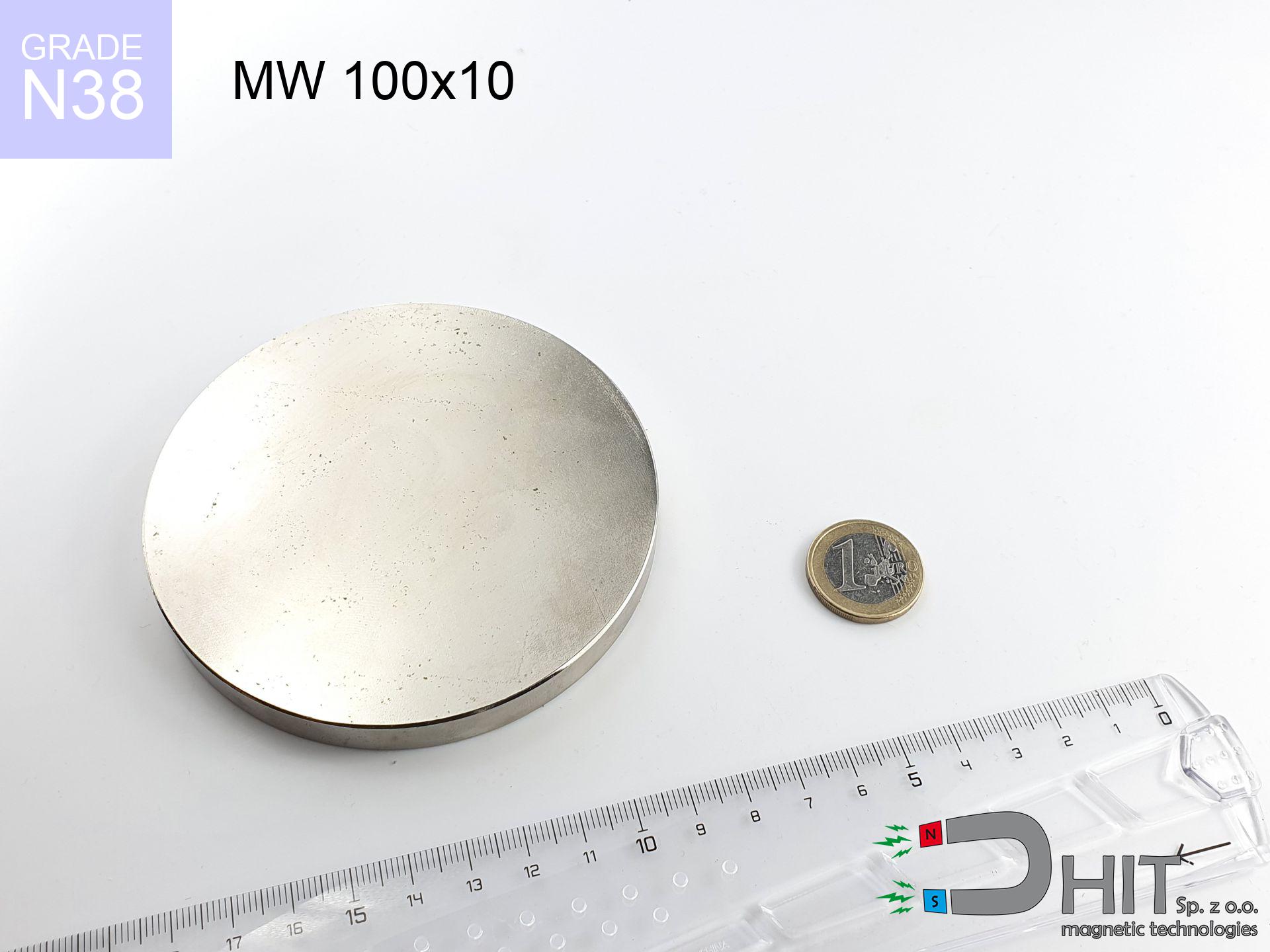
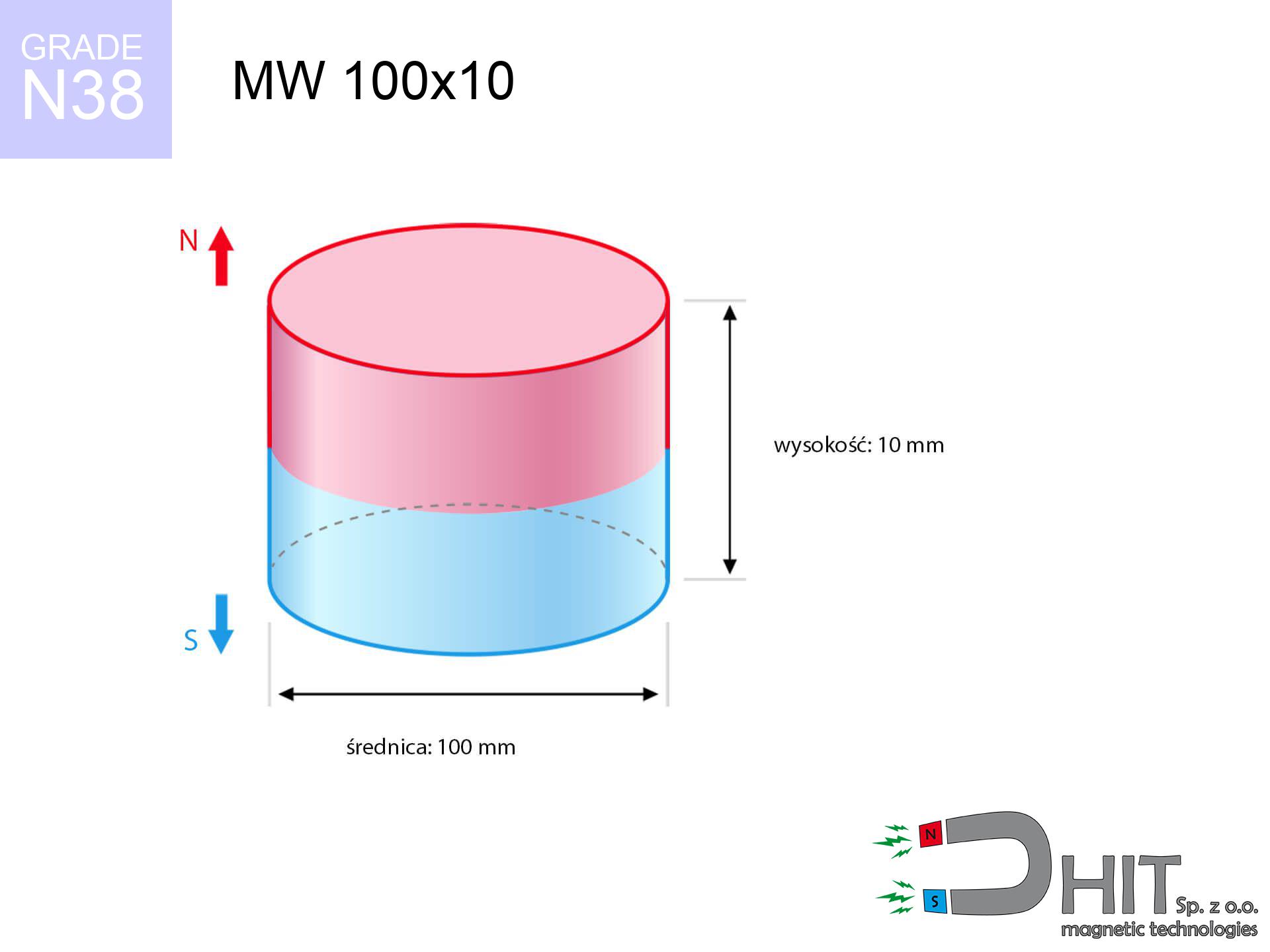
MW 100x10 / N38 - cylindrical magnet
cylindrical magnet
Catalog no 010001
GTIN/EAN: 5906301810018
- Diameter Ø
- 100 mm [±0,1 mm]
- Height
- 10 mm [±0,1 mm]
- Weight
- 589.05 g
- Magnetization Direction
- ↑ axial
- Coating
- [NiCuNi] Nickel
How we measure these parameters — certificates and measurements
299.59 zł net / pcs
368.50 zł with VAT (23% VAT) / pcs
bulk discounts:
Need more?Frequently asked questions
Where can I buy strong cylindrical neodymium magnets?
Can a small cylindrical magnet provide a strong grip for precise workshop work?
Which cylindrical magnet can work at a higher temperature?
Engineering report for this magnet
Full PDF analysis: pull and shear force, effect of distance, temperature and plate thickness, safety distances and the demagnetization curve.
Call us now
+48 888 99 98 98
alternatively let us know using
contact form
the contact section.
Specifications and structure of a neodymium magnet can be estimated using our
power calculator.
Order by 14:00 and we’ll ship today!
Technical parameters of the product - MW 100x10 / N38 - cylindrical magnet
Specification / characteristics - MW 100x10 / N38 - cylindrical magnet
| properties | values |
|---|---|
| Cat. no. | 010001 |
| GTIN/EAN | 5906301810018 |
| Production/Distribution | Dhit sp. z o.o. |
| Country of origin | Poland / China / Germany |
| Customs code | 85059029 |
| Diameter Ø | 100 mm [±0,1 mm] |
| Height | 10 mm [±0,1 mm] |
| Weight | 589.05 g |
| Magnetization Direction | ↑ axial |
| Load capacity ~ ? | 40.86 kg / 400.80 N |
| Magnetic Induction ~ ? | 121.59 mT / 1216 Gs |
| Coating | [NiCuNi] Nickel |
| Manufacturing Tolerance | ±0.1 mm |
Magnetic properties of material N38
| properties | values | units |
|---|---|---|
| Remanence Br ? | 12.2-12.6 | kGs |
| Remanence Br ? | 1220-1260 | mT |
| Coercivity bHc ? | 10.8-11.5 | kOe |
| Coercivity bHc ? | 860-915 | kA/m |
| Intrinsic coercivity iHc | ≥ 12 | kOe |
| Intrinsic coercivity iHc | ≥ 955 | kA/m |
| Energy product BHmax ? | 36-38 | BH max MGOe |
| Energy product BHmax ? | 287-303 | BH max KJ/m |
| Maximum working temperature ? | ≤ 80 | °C |
Physical properties of sintered neodymium magnets Nd2Fe14B at 20°C
| properties | values | units |
|---|---|---|
| Vickers hardness | ≥550 | Hv |
| Density | ≥7.4 | g/cm3 |
| Curie Temperature TC | 310 | °C |
| Curie Temperature TF | 590 | °F |
| Specific resistance | 150 | μΩ⋅cm |
| Bending strength | 250 | MPa |
| Compressive strength | 1000~1100 | MPa |
| Thermal expansion parallel (∥) to orientation (M) | (3-4) x 10-6 | °C-1 |
| Thermal expansion perpendicular (⊥) to orientation (M) | -(1-3) x 10-6 | °C-1 |
| Young's modulus | 1.7 x 10⁴ | kg/mm² |
Technical simulation of the product - data
Presented data are the direct effect of a mathematical simulation. Values were calculated on models for the material Nd2Fe14B. Operational parameters may differ. Use these data as a preliminary roadmap when designing systems.
Table 1: Static force (force vs gap) - interaction chart
MW 100x10 / N38
| Distance (mm) | Induction (Gauss) / mT | Pull Force (kg/lbs/g/N) | Risk Status |
|---|---|---|---|
| 0 mm |
1216 Gs
121.6 mT
|
40.86 kg / 90.08 pounds
40860.0 g / 400.8 N
|
crushing |
| 1 mm |
1208 Gs
120.8 mT
|
40.35 kg / 88.95 pounds
40345.4 g / 395.8 N
|
crushing |
| 2 mm |
1199 Gs
119.9 mT
|
39.74 kg / 87.62 pounds
39742.7 g / 389.9 N
|
crushing |
| 3 mm |
1189 Gs
118.9 mT
|
39.06 kg / 86.12 pounds
39062.0 g / 383.2 N
|
crushing |
| 5 mm |
1165 Gs
116.5 mT
|
37.49 kg / 82.65 pounds
37490.2 g / 367.8 N
|
crushing |
| 10 mm |
1087 Gs
108.7 mT
|
32.64 kg / 71.96 pounds
32640.7 g / 320.2 N
|
crushing |
| 15 mm |
991 Gs
99.1 mT
|
27.15 kg / 59.86 pounds
27153.9 g / 266.4 N
|
crushing |
| 20 mm |
887 Gs
88.7 mT
|
21.76 kg / 47.97 pounds
21758.7 g / 213.5 N
|
crushing |
| 30 mm |
683 Gs
68.3 mT
|
12.90 kg / 28.45 pounds
12902.7 g / 126.6 N
|
crushing |
| 50 mm |
379 Gs
37.9 mT
|
3.97 kg / 8.75 pounds
3968.4 g / 38.9 N
|
strong |
Table 2: Vertical capacity (vertical surface)
MW 100x10 / N38
| Distance (mm) | Friction coefficient | Pull Force (kg/lbs/g/N) |
|---|---|---|
| 0 mm | Stal (~0.2) |
8.17 kg / 18.02 pounds
8172.0 g / 80.2 N
|
| 1 mm | Stal (~0.2) |
8.07 kg / 17.79 pounds
8070.0 g / 79.2 N
|
| 2 mm | Stal (~0.2) |
7.95 kg / 17.52 pounds
7948.0 g / 78.0 N
|
| 3 mm | Stal (~0.2) |
7.81 kg / 17.22 pounds
7812.0 g / 76.6 N
|
| 5 mm | Stal (~0.2) |
7.50 kg / 16.53 pounds
7498.0 g / 73.6 N
|
| 10 mm | Stal (~0.2) |
6.53 kg / 14.39 pounds
6528.0 g / 64.0 N
|
| 15 mm | Stal (~0.2) |
5.43 kg / 11.97 pounds
5430.0 g / 53.3 N
|
| 20 mm | Stal (~0.2) |
4.35 kg / 9.59 pounds
4352.0 g / 42.7 N
|
| 30 mm | Stal (~0.2) |
2.58 kg / 5.69 pounds
2580.0 g / 25.3 N
|
| 50 mm | Stal (~0.2) |
0.79 kg / 1.75 pounds
794.0 g / 7.8 N
|
Table 3: Vertical assembly (sliding) - vertical pull
MW 100x10 / N38
| Surface type | Friction coefficient / % Mocy | Max load (kg/lbs/g/N) |
|---|---|---|
| Raw steel |
µ = 0.3
30% Nominalnej Siły
|
12.26 kg / 27.02 pounds
12258.0 g / 120.3 N
|
| Painted steel (standard) |
µ = 0.2
20% Nominalnej Siły
|
8.17 kg / 18.02 pounds
8172.0 g / 80.2 N
|
| Oily/slippery steel |
µ = 0.1
10% Nominalnej Siły
|
4.09 kg / 9.01 pounds
4086.0 g / 40.1 N
|
| Magnet with anti-slip rubber |
µ = 0.5
50% Nominalnej Siły
|
20.43 kg / 45.04 pounds
20430.0 g / 200.4 N
|
Table 4: Material efficiency (saturation) - power losses
MW 100x10 / N38
| Steel thickness (mm) | % power | Real pull force (kg/lbs/g/N) |
|---|---|---|
| 0.5 mm |
|
2.04 kg / 4.50 pounds
2043.0 g / 20.0 N
|
| 1 mm |
|
5.11 kg / 11.26 pounds
5107.5 g / 50.1 N
|
| 2 mm |
|
10.22 kg / 22.52 pounds
10215.0 g / 100.2 N
|
| 3 mm |
|
15.32 kg / 33.78 pounds
15322.5 g / 150.3 N
|
| 5 mm |
|
25.54 kg / 56.30 pounds
25537.5 g / 250.5 N
|
| 10 mm |
|
40.86 kg / 90.08 pounds
40860.0 g / 400.8 N
|
| 11 mm |
|
40.86 kg / 90.08 pounds
40860.0 g / 400.8 N
|
| 12 mm |
|
40.86 kg / 90.08 pounds
40860.0 g / 400.8 N
|
Table 5: Thermal stability (stability) - power drop
MW 100x10 / N38
| Ambient temp. (°C) | Power loss | Remaining pull (kg/lbs/g/N) | Status |
|---|---|---|---|
| 20 °C | 0.0% |
40.86 kg / 90.08 pounds
40860.0 g / 400.8 N
|
OK |
| 40 °C | -2.2% |
39.96 kg / 88.10 pounds
39961.1 g / 392.0 N
|
OK |
| 60 °C | -4.4% |
39.06 kg / 86.12 pounds
39062.2 g / 383.2 N
|
|
| 80 °C | -6.6% |
38.16 kg / 84.14 pounds
38163.2 g / 374.4 N
|
|
| 100 °C | -28.8% |
29.09 kg / 64.14 pounds
29092.3 g / 285.4 N
|
Table 6: Magnet-Magnet interaction (repulsion) - field collision
MW 100x10 / N38
| Gap (mm) | Attraction (kg/lbs) (N-S) | Shear Strength (kg/lbs/g/N) | Repulsion (kg/lbs) (N-N) |
|---|---|---|---|
| 0 mm |
71.58 kg / 157.80 pounds
2 302 Gs
|
10.74 kg / 23.67 pounds
10737 g / 105.3 N
|
N/A |
| 1 mm |
71.15 kg / 156.86 pounds
2 424 Gs
|
10.67 kg / 23.53 pounds
10673 g / 104.7 N
|
64.04 kg / 141.17 pounds
~0 Gs
|
| 2 mm |
70.68 kg / 155.82 pounds
2 416 Gs
|
10.60 kg / 23.37 pounds
10602 g / 104.0 N
|
63.61 kg / 140.23 pounds
~0 Gs
|
| 3 mm |
70.17 kg / 154.69 pounds
2 408 Gs
|
10.53 kg / 23.20 pounds
10525 g / 103.3 N
|
63.15 kg / 139.22 pounds
~0 Gs
|
| 5 mm |
69.04 kg / 152.21 pounds
2 388 Gs
|
10.36 kg / 22.83 pounds
10356 g / 101.6 N
|
62.14 kg / 136.99 pounds
~0 Gs
|
| 10 mm |
65.68 kg / 144.79 pounds
2 329 Gs
|
9.85 kg / 21.72 pounds
9851 g / 96.6 N
|
59.11 kg / 130.31 pounds
~0 Gs
|
| 20 mm |
57.18 kg / 126.06 pounds
2 173 Gs
|
8.58 kg / 18.91 pounds
8577 g / 84.1 N
|
51.46 kg / 113.45 pounds
~0 Gs
|
| 50 mm |
29.67 kg / 65.40 pounds
1 565 Gs
|
4.45 kg / 9.81 pounds
4450 g / 43.7 N
|
26.70 kg / 58.86 pounds
~0 Gs
|
| 60 mm |
22.60 kg / 49.83 pounds
1 366 Gs
|
3.39 kg / 7.47 pounds
3390 g / 33.3 N
|
20.34 kg / 44.85 pounds
~0 Gs
|
| 70 mm |
16.98 kg / 37.43 pounds
1 184 Gs
|
2.55 kg / 5.61 pounds
2546 g / 25.0 N
|
15.28 kg / 33.68 pounds
~0 Gs
|
| 80 mm |
12.64 kg / 27.87 pounds
1 022 Gs
|
1.90 kg / 4.18 pounds
1896 g / 18.6 N
|
11.38 kg / 25.08 pounds
~0 Gs
|
| 90 mm |
9.38 kg / 20.67 pounds
880 Gs
|
1.41 kg / 3.10 pounds
1406 g / 13.8 N
|
8.44 kg / 18.60 pounds
~0 Gs
|
| 100 mm |
6.95 kg / 15.33 pounds
758 Gs
|
1.04 kg / 2.30 pounds
1043 g / 10.2 N
|
6.26 kg / 13.79 pounds
~0 Gs
|
Table 7: Protective zones (electronics) - warnings
MW 100x10 / N38
| Object / Device | Limit (Gauss) / mT | Safe distance |
|---|---|---|
| Pacemaker | 5 Gs (0.5 mT) | 31.0 cm |
| Hearing aid | 10 Gs (1.0 mT) | 24.0 cm |
| Timepiece | 20 Gs (2.0 mT) | 19.0 cm |
| Mobile device | 40 Gs (4.0 mT) | 14.5 cm |
| Remote | 50 Gs (5.0 mT) | 13.5 cm |
| Payment card | 400 Gs (40.0 mT) | 5.0 cm |
| HDD hard drive | 600 Gs (60.0 mT) | 3.5 cm |
Table 8: Dynamics (kinetic energy) - collision effects
MW 100x10 / N38
| Start from (mm) | Speed (km/h) | Energy (J) | Predicted outcome |
|---|---|---|---|
| 10 mm |
12.68 km/h
(3.52 m/s)
|
3.65 J | |
| 30 mm |
18.75 km/h
(5.21 m/s)
|
7.99 J | |
| 50 mm |
20.43 km/h
(5.68 m/s)
|
9.49 J | |
| 100 mm |
21.11 km/h
(5.87 m/s)
|
10.13 J |
Table 9: Corrosion resistance
MW 100x10 / N38
| Technical parameter | Value / Description |
|---|---|
| Coating type | [NiCuNi] Nickel |
| Layer structure | Nickel - Copper - Nickel |
| Layer thickness | 10-20 µm |
| Salt spray test (SST) ? | 24 h |
| Recommended environment | Indoors only (dry) |
Table 10: Construction data (Pc)
MW 100x10 / N38
| Parameter | Value | SI Unit / Description |
|---|---|---|
| Magnetic Flux | 125 951 Mx | 1259.5 µWb |
| Pc Coefficient | 0.16 | Low (Flat) |
Table 11: Hydrostatics and buoyancy
MW 100x10 / N38
| Environment | Effective steel pull | Effect |
|---|---|---|
| Air (land) | 40.86 kg | Standard |
| Water (riverbed) |
46.78 kg
(+5.92 kg buoyancy gain)
|
+14.5% |
1. Shear force
*Note: On a vertical surface, the magnet retains merely approx. 20-30% of its nominal pull.
2. Steel thickness impact
*Thin steel (e.g. 0.5mm PC case) significantly limits the holding force.
3. Power loss vs temp
N38: the maximum material working temperature is 80°C. Permitted conditions also depend on the shape and magnetic circuit.
4. Demagnetization curve and operating point (B-H)
chart generated for the permeance coefficient Pc (Permeance Coefficient) = 0.16
The chart above illustrates the magnetic characteristics of the material within the second quadrant of the hysteresis loop. The solid red line represents the demagnetization curve (material potential), while the dashed blue line is the load line based on the magnet's geometry. The Pc (Permeance Coefficient), also known as the load line slope, is a dimensionless value that describes the relationship between the magnet's shape and its magnetic stability. The intersection of these two lines (the black dot) is the operating point — it determines the actual magnetic flux density generated by the magnet in this specific configuration. A higher Pc value means the magnet is more 'slender' (tall relative to its area), resulting in a higher operating point and better resistance to irreversible demagnetization caused by external fields or temperature. A value of 0.42 is relatively low (typical for flat magnets), meaning the operating point is closer to the 'knee' of the curve — caution is advised when operating at temperatures near the maximum limit to avoid strength loss.
Material specification
| iron (Fe) | 64% – 68% |
| neodymium (Nd) | 29% – 32% |
| boron (B) | 1.1% – 1.2% |
| dysprosium (Dy) | 0.5% – 2.0% |
| coating (Ni-Cu-Ni) | < 0.05% |
Environmental data
| recyclability (EoL) | 100% |
| recycled raw materials | ~10% (pre-cons) |
| carbon footprint | low / zredukowany |
| waste code (EWC) | 16 02 16 |
Other offers
![UMH 16x5x32 [M4] / N38 - magnetic holder with hook](https://cdn3.dhit.pl/graphics/products/umh-16x5x32-m4-lak.jpg "UMH 16x5x32 [M4] / N38 - magnetic holder with hook")
![UMGW 32x18x8 [M6] GW / N38 - magnetic holder internal thread](https://cdn3.dhit.pl/graphics/products/um32x18x8-m6-gw--hec.jpg "UMGW 32x18x8 [M6] GW / N38 - magnetic holder internal thread")
Strengths as well as weaknesses of neodymium magnets.
Advantages
- They retain attractive force for around 10 years – the loss is just ~1% (in theory),
- They show high resistance to demagnetization induced by external disturbances,
- By using a decorative layer of gold, the element presents an modern look,
- Magnets are characterized by impressive magnetic induction on the outer side,
- Thanks to resistance to high temperature, they are able to function (depending on the form) even at temperatures up to 230°C and higher...
- Thanks to the possibility of free molding and customization to specialized projects, neodymium magnets can be modeled in a wide range of forms and dimensions, which increases their versatility,
- Huge importance in future technologies – they are utilized in data components, drive modules, precision medical tools, as well as industrial machines.
- Relatively small size with high pulling force – neodymium magnets offer strong magnetic field in small dimensions, which makes them useful in small systems
Cons
- Brittleness is one of their disadvantages. Upon intense impact they can fracture. We advise keeping them in a special holder, which not only secures them against impacts but also raises their durability
- Do not exceed this material temperature limit: 80°C. Overheating may permanently weaken the magnet.
- Due to the susceptibility of magnets to corrosion in a humid environment, we suggest using waterproof magnets made of rubber, plastic or other material immune to moisture, in case of application outdoors
- We suggest casing - magnetic mount, due to difficulties in producing threads inside the magnet and complicated shapes.
- Potential hazard related to microscopic parts of magnets are risky, if swallowed, which is particularly important in the aspect of protecting the youngest. Additionally, tiny parts of these devices can disrupt the diagnostic process medical after entering the body.
- High unit price – neodymium magnets have a higher price than other types of magnets (e.g. ferrite), which hinders application in large quantities
Holding force characteristics
Optimal lifting capacity of a neodymium magnet – what contributes to it?
- on a plate made of structural steel, perfectly concentrating the magnetic flux
- possessing a massiveness of minimum 10 mm to ensure full flux closure
- with a plane perfectly flat
- under conditions of no distance (metal-to-metal)
- during pulling in a direction perpendicular to the mounting surface
- at temperature room level
Practical lifting capacity: influencing factors
- Distance (between the magnet and the plate), as even a tiny clearance (e.g. 0.5 mm) leads to a decrease in force by up to 50% (this also applies to paint, rust or dirt).
- Force direction – remember that the magnet holds strongest perpendicularly. Under sliding down, the capacity drops significantly, often to levels of 20-30% of the nominal value.
- Metal thickness – the thinner the sheet, the weaker the hold. Part of the magnetic field passes through the material instead of converting into lifting capacity.
- Steel type – low-carbon steel attracts best. Higher carbon content reduce magnetic permeability and lifting capacity.
- Plate texture – smooth surfaces guarantee perfect abutment, which increases force. Rough surfaces weaken the grip.
- Heat – NdFeB sinters have a sensitivity to temperature. At higher temperatures they are weaker, and at low temperatures gain strength (up to a certain limit).
Lifting capacity was measured with the use of a polished steel plate of optimal thickness (min. 20 mm), under perpendicular detachment force, whereas under parallel forces the load capacity is reduced by as much as fivefold. In addition, even a slight gap between the magnet and the plate decreases the load capacity.
Precautions when working with neodymium magnets
Health Danger
Life threat: Strong magnets can deactivate heart devices and defibrillators. Stay away if you have electronic implants.
Compass and GPS
Remember: neodymium magnets generate a field that interferes with sensitive sensors. Maintain a separation from your phone, tablet, and GPS.
Risk of cracking
Neodymium magnets are ceramic materials, meaning they are prone to chipping. Impact of two magnets leads to them shattering into small pieces.
Allergic reactions
Nickel alert: The Ni-Cu-Ni coating consists of nickel. If an allergic reaction happens, immediately stop working with magnets and use protective gear.
Data carriers
Powerful magnetic fields can erase data on credit cards, HDDs, and storage devices. Stay away of min. 10 cm.
Keep away from children
Always keep magnets away from children. Ingestion danger is high, and the effects of magnets connecting inside the body are tragic.
Pinching danger
Watch your fingers. Two powerful magnets will join immediately with a force of several hundred kilograms, crushing anything in their path. Exercise extreme caution!
Do not underestimate power
Use magnets consciously. Their immense force can shock even experienced users. Be vigilant and do not underestimate their power.
Dust explosion hazard
Fire hazard: Rare earth powder is highly flammable. Avoid machining magnets in home conditions as this risks ignition.
Heat sensitivity
Control the heat. Heating the magnet above 80 degrees Celsius will permanently weaken its magnetic structure and pulling force.
Tabela kosztu i czasu dostawy
Płatność przed wysyłką:

GLS kurier
Przesyłka będzie u Ciebie za 2-3 dni
14.99 ZŁ

InPost Paczkomaty 24/7
Przesyłka będzie u Ciebie za 1-2 dni
12.30 ZŁ
Płatność przy odbiorze (pobranie):
GLS kurier
Przesyłka będzie u Ciebie za 1-2 dni
23.00 ZŁ