

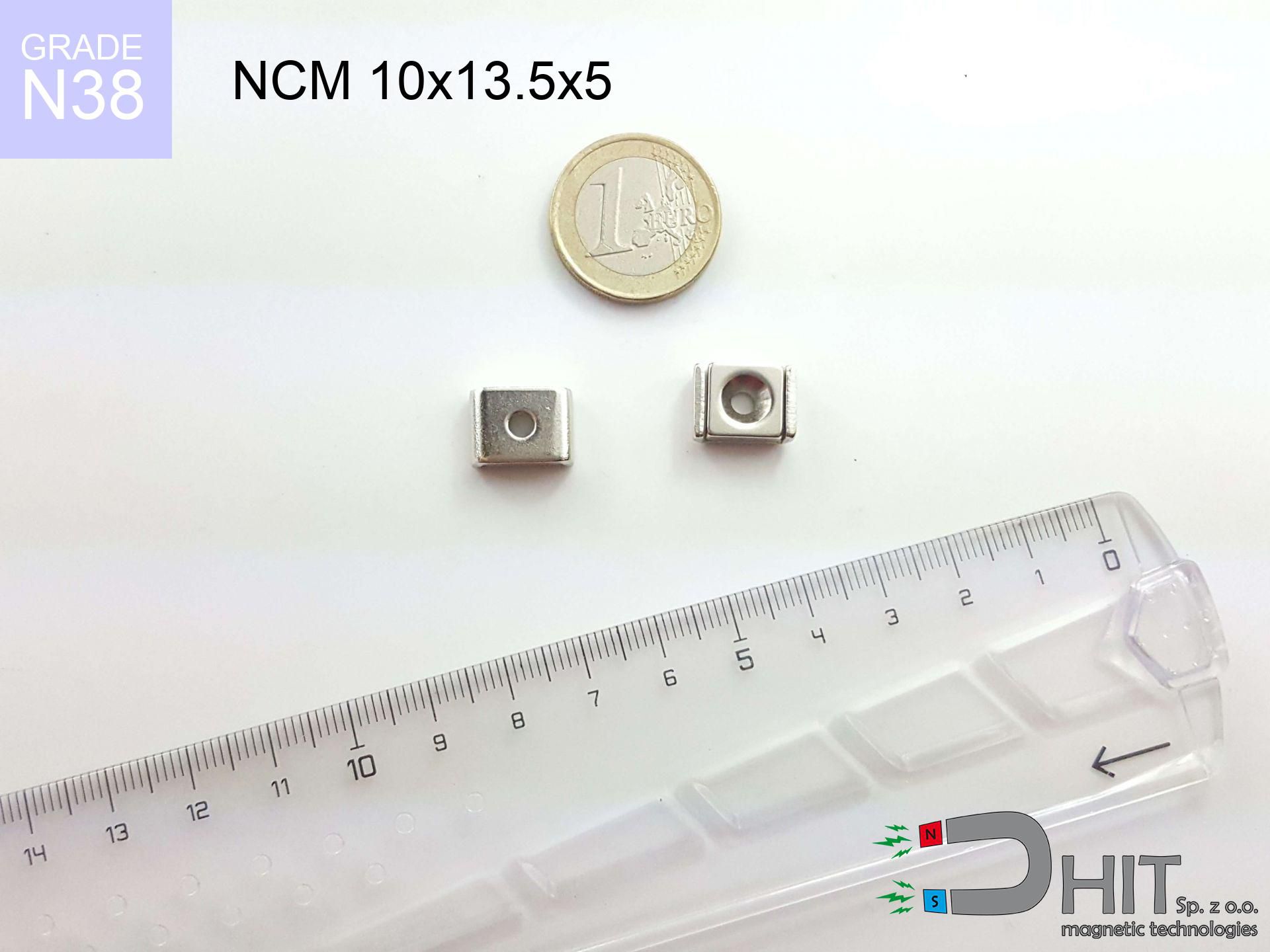
NCM 10x13.5x5 / N38 - channel magnetic holder
channel magnetic holder
Catalog no 360485
GTIN/EAN: 5906301814849
- Diameter Ø
- 10 mm [±1 mm]
- Height
- 13.5 mm [±1 mm]
- Weight
- 4.5 g
- Magnetization Direction
- ↑ axial
- Coating
- [NiCuNi] Nickel
How we measure these parameters — certificates and measurements
2.76 zł net / pcs
3.39 zł with VAT (23% VAT) / pcs
bulk discounts:
Need more?Frequently asked questions
Which magnetic holder is suitable for moving metal parts in a workshop?
How do I choose a holder for hanging a heavy item and check its real grip?
Which magnetic holders can be used outdoors?
How should I choose a strong threaded holder for field work?
Call us now
+48 888 99 98 98
alternatively let us know using
contact form
the contact section.
Specifications and structure of a neodymium magnet can be estimated using our
power calculator.
Order by 14:00 and we’ll ship today!
Physical properties - NCM 10x13.5x5 / N38 - channel magnetic holder
Specification / characteristics - NCM 10x13.5x5 / N38 - channel magnetic holder
| properties | values |
|---|---|
| Cat. no. | 360485 |
| GTIN/EAN | 5906301814849 |
| Production/Distribution | Dhit sp. z o.o. |
| Country of origin | Poland / China / Germany |
| Customs code | 85059029 |
| Diameter Ø | 10 mm [±1 mm] |
| Height | 13.5 mm [±1 mm] |
| Weight | 4.5 g |
| Magnetization Direction | ↑ axial |
| Load capacity ~ ? | 4.00 kg / 39.23 N |
| Coating | [NiCuNi] Nickel |
| Manufacturing Tolerance | ±1 mm |
Magnetic properties of material N38
| properties | values | units |
|---|---|---|
| Remanence Br ? | 12.2-12.6 | kGs |
| Remanence Br ? | 1220-1260 | mT |
| Coercivity bHc ? | 10.8-11.5 | kOe |
| Coercivity bHc ? | 860-915 | kA/m |
| Intrinsic coercivity iHc | ≥ 12 | kOe |
| Intrinsic coercivity iHc | ≥ 955 | kA/m |
| Energy product BHmax ? | 36-38 | BH max MGOe |
| Energy product BHmax ? | 287-303 | BH max KJ/m |
| Maximum working temperature ? | ≤ 80 | °C |
Physical properties of sintered neodymium magnets Nd2Fe14B at 20°C
| properties | values | units |
|---|---|---|
| Vickers hardness | ≥550 | Hv |
| Density | ≥7.4 | g/cm3 |
| Curie Temperature TC | 310 | °C |
| Curie Temperature TF | 590 | °F |
| Specific resistance | 150 | μΩ⋅cm |
| Bending strength | 250 | MPa |
| Compressive strength | 1000~1100 | MPa |
| Thermal expansion parallel (∥) to orientation (M) | (3-4) x 10-6 | °C-1 |
| Thermal expansion perpendicular (⊥) to orientation (M) | -(1-3) x 10-6 | °C-1 |
| Young's modulus | 1.7 x 10⁴ | kg/mm² |
Chemical composition
| iron (Fe) | 64% – 68% |
| neodymium (Nd) | 29% – 32% |
| boron (B) | 1.1% – 1.2% |
| dysprosium (Dy) | 0.5% – 2.0% |
| coating (Ni-Cu-Ni) | < 0.05% |
Sustainability
| recyclability (EoL) | 100% |
| recycled raw materials | ~10% (pre-cons) |
| carbon footprint | low / zredukowany |
| waste code (EWC) | 16 02 16 |
Other products
![SM 32x225 [2xM8] / N52 - magnetic separator](https://cdn3.dhit.pl/graphics/products/sm-32x225-2xm8-zix.jpg "SM 32x225 [2xM8] / N52 - magnetic separator")


Strengths and weaknesses of neodymium magnets.
Advantages
- They retain magnetic properties for nearly 10 years – the loss is just ~1% (in theory),
- They retain their magnetic properties even under strong external field,
- Thanks to the metallic finish, the coating of Ni-Cu-Ni, gold, or silver-plated gives an clean appearance,
- They feature high magnetic induction at the operating surface, which increases their power,
- Neodymium magnets are characterized by very high magnetic induction on the magnet surface and can work (depending on the form) even at a temperature of 230°C or more...
- Possibility of accurate machining as well as adjusting to precise requirements,
- Key role in electronics industry – they serve a role in HDD drives, drive modules, diagnostic systems, and modern systems.
- Thanks to efficiency per cm³, small magnets offer high operating force, with minimal size,
Disadvantages
- They are prone to damage upon heavy impacts. To avoid cracks, it is worth protecting magnets in a protective case. Such protection not only protects the magnet but also increases its resistance to damage
- Do not exceed this material temperature limit: 80°C. Overheating may permanently weaken the magnet.
- When exposed to humidity, magnets start to rust. To use them in conditions outside, it is recommended to use protective magnets, such as those in rubber or plastics, which secure oxidation as well as corrosion.
- We suggest cover - magnetic mechanism, due to difficulties in producing nuts inside the magnet and complicated forms.
- Potential hazard resulting from small fragments of magnets can be dangerous, when accidentally swallowed, which becomes key in the aspect of protecting the youngest. Additionally, tiny parts of these devices are able to disrupt the diagnostic process medical in case of swallowing.
- Higher cost of purchase is one of the disadvantages compared to ceramic magnets, especially in budget applications
Lifting parameters
Maximum magnetic pulling force – what it depends on?
- using a base made of low-carbon steel, acting as a magnetic yoke
- with a thickness of at least 10 mm
- characterized by even structure
- under conditions of gap-free contact (metal-to-metal)
- under perpendicular application of breakaway force (90-degree angle)
- at temperature approx. 20 degrees Celsius
What influences lifting capacity in practice
- Distance – existence of any layer (paint, tape, air) acts as an insulator, which reduces capacity steeply (even by 50% at 0.5 mm).
- Angle of force application – maximum parameter is obtained only during perpendicular pulling. The force required to slide of the magnet along the plate is typically several times smaller (approx. 1/5 of the lifting capacity).
- Substrate thickness – to utilize 100% power, the steel must be sufficiently thick. Thin sheet restricts the attraction force (the magnet "punches through" it).
- Material composition – not every steel attracts identically. Alloy additives worsen the attraction effect.
- Base smoothness – the more even the plate, the larger the contact zone and higher the lifting capacity. Roughness acts like micro-gaps.
- Thermal environment – temperature increase causes a temporary drop of induction. Check the thermal limit for a given model.
Holding force was measured on a smooth steel plate of 20 mm thickness, when the force acted perpendicularly, in contrast under parallel forces the load capacity is reduced by as much as 75%. In addition, even a small distance between the magnet and the plate lowers the holding force.
Safety rules for work with NdFeB magnets
Maximum temperature
Watch the temperature. Heating the magnet to high heat will permanently weaken its magnetic structure and strength.
Metal Allergy
Nickel alert: The Ni-Cu-Ni coating consists of nickel. If skin irritation happens, immediately stop handling magnets and use protective gear.
Implant safety
Medical warning: Neodymium magnets can turn off heart devices and defibrillators. Do not approach if you have medical devices.
Material brittleness
Beware of splinters. Magnets can fracture upon uncontrolled impact, launching shards into the air. Eye protection is mandatory.
Magnetic media
Device Safety: Strong magnets can damage payment cards and sensitive devices (heart implants, hearing aids, mechanical watches).
Safe operation
Before starting, check safety instructions. Sudden snapping can destroy the magnet or hurt your hand. Think ahead.
Machining danger
Drilling and cutting of NdFeB material poses a fire risk. Magnetic powder oxidizes rapidly with oxygen and is difficult to extinguish.
Precision electronics
GPS units and smartphones are extremely sensitive to magnetism. Direct contact with a strong magnet can permanently damage the sensors in your phone.
Physical harm
Watch your fingers. Two powerful magnets will snap together instantly with a force of massive weight, crushing anything in their path. Be careful!
No play value
Only for adults. Small elements pose a choking risk, leading to severe trauma. Keep out of reach of children and animals.
Tabela kosztu i czasu dostawy
Płatność przed wysyłką:

GLS kurier
Przesyłka będzie u Ciebie za 2-3 dni
14.99 ZŁ

InPost Paczkomaty 24/7
Przesyłka będzie u Ciebie za 1-2 dni
12.30 ZŁ
Płatność przy odbiorze (pobranie):
GLS kurier
Przesyłka będzie u Ciebie za 1-2 dni
23.00 ZŁ