

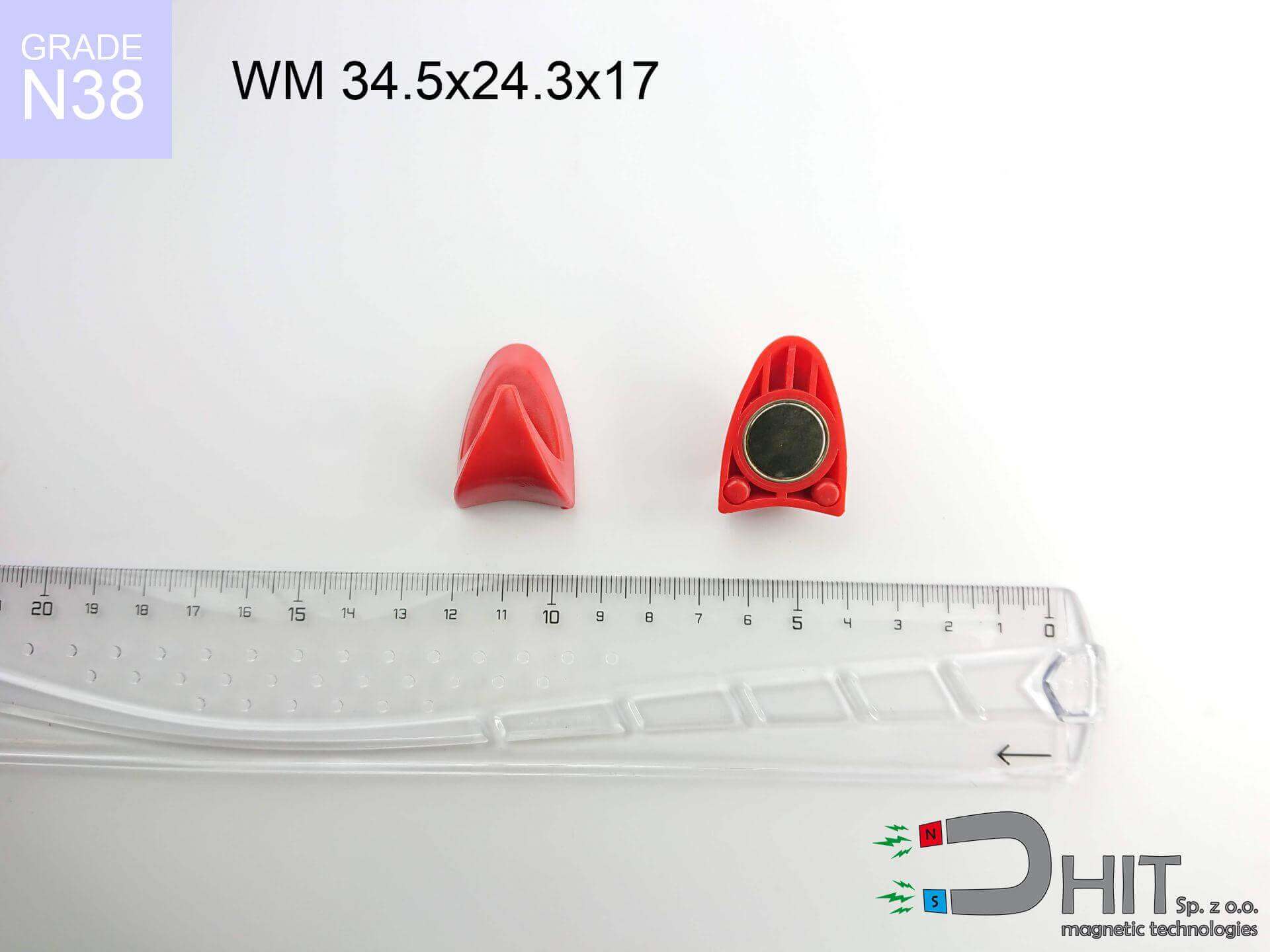

WM 34.5x24.3x17 / N38 - magnetic hanger
magnetic hanger
Catalog no 240215
GTIN/EAN: 5906301814382
- length
- 34.5 mm [±1 mm]
- Width
- 24.3 mm [±1 mm]
- Height
- 17 mm [±1 mm]
- Weight
- 9 g
- Coating
- [NiCuNi] Nickel
How we measure these parameters — certificates and measurements
4.06 zł net / pcs
4.99 zł with VAT (23% VAT) / pcs
bulk discounts:
Need more?Frequently asked questions
Which magnetic holder is suitable for moving metal parts in a workshop?
How do I choose a holder for hanging a heavy item and check its real grip?
Which magnetic holders can be used outdoors?
How should I choose a strong threaded holder for field work?
Call us now
+48 888 99 98 98
alternatively let us know using
contact form
the contact section.
Specifications and structure of a neodymium magnet can be estimated using our
power calculator.
Order by 14:00 and we’ll ship today!
Detailed specification - WM 34.5x24.3x17 / N38 - magnetic hanger
Specification / characteristics - WM 34.5x24.3x17 / N38 - magnetic hanger
| properties | values |
|---|---|
| Cat. no. | 240215 |
| GTIN/EAN | 5906301814382 |
| Production/Distribution | Dhit sp. z o.o. |
| Country of origin | Poland / China / Germany |
| Customs code | 85059029 |
| length | 34.5 mm [±1 mm] |
| Width | 24.3 mm [±1 mm] |
| Height | 17 mm [±1 mm] |
| Weight | 9 g |
| Coating | [NiCuNi] Nickel |
| Manufacturing Tolerance | ±1 mm |
Magnetic properties of material N38
| properties | values | units |
|---|---|---|
| Remanence Br ? | 12.2-12.6 | kGs |
| Remanence Br ? | 1220-1260 | mT |
| Coercivity bHc ? | 10.8-11.5 | kOe |
| Coercivity bHc ? | 860-915 | kA/m |
| Intrinsic coercivity iHc | ≥ 12 | kOe |
| Intrinsic coercivity iHc | ≥ 955 | kA/m |
| Energy product BHmax ? | 36-38 | BH max MGOe |
| Energy product BHmax ? | 287-303 | BH max KJ/m |
| Maximum working temperature ? | ≤ 80 | °C |
Physical properties of sintered neodymium magnets Nd2Fe14B at 20°C
| properties | values | units |
|---|---|---|
| Vickers hardness | ≥550 | Hv |
| Density | ≥7.4 | g/cm3 |
| Curie Temperature TC | 310 | °C |
| Curie Temperature TF | 590 | °F |
| Specific resistance | 150 | μΩ⋅cm |
| Bending strength | 250 | MPa |
| Compressive strength | 1000~1100 | MPa |
| Thermal expansion parallel (∥) to orientation (M) | (3-4) x 10-6 | °C-1 |
| Thermal expansion perpendicular (⊥) to orientation (M) | -(1-3) x 10-6 | °C-1 |
| Young's modulus | 1.7 x 10⁴ | kg/mm² |
Material specification
| iron (Fe) | 64% – 68% |
| neodymium (Nd) | 29% – 32% |
| boron (B) | 1.1% – 1.2% |
| dysprosium (Dy) | 0.5% – 2.0% |
| coating (Ni-Cu-Ni) | < 0.05% |
Environmental data
| recyclability (EoL) | 100% |
| recycled raw materials | ~10% (pre-cons) |
| carbon footprint | low / zredukowany |
| waste code (EWC) | 16 02 16 |
View more offers

![SM 25x150 [2xM8] / N52 - magnetic separator](https://cdn3.dhit.pl/graphics/products/sm-25x150-2xm8-sux.jpg "SM 25x150 [2xM8] / N52 - magnetic separator")
![HH 32x7.8 [M5] / N38 - through hole magnetic holder](https://cdn3.dhit.pl/graphics/products/hh-32x7.8-m5-war.jpg "HH 32x7.8 [M5] / N38 - through hole magnetic holder")
Advantages as well as disadvantages of neodymium magnets.
Benefits
- They have stable power, and over around ten years their attraction force decreases symbolically – ~1% (in testing),
- Magnets effectively defend themselves against demagnetization caused by external fields,
- Thanks to the shiny finish, the layer of nickel, gold-plated, or silver gives an clean appearance,
- Magnets are distinguished by very high magnetic induction on the outer side,
- Made from properly selected components, these magnets show impressive resistance to high heat, enabling them to function (depending on their form) at temperatures up to 230°C and above...
- Thanks to the ability of free molding and adaptation to individualized projects, magnetic components can be modeled in a wide range of shapes and sizes, which increases their versatility,
- Significant place in modern technologies – they find application in magnetic memories, electromotive mechanisms, medical devices, also industrial machines.
- Thanks to efficiency per cm³, small magnets offer high operating force, occupying minimum space,
Weaknesses
- To avoid cracks under impact, we recommend using special steel housings. Such a solution secures the magnet and simultaneously increases its durability.
- Do not exceed this material temperature limit: 80°C. Overheating may permanently weaken the magnet.
- Due to the susceptibility of magnets to corrosion in a humid environment, we recommend using waterproof magnets made of rubber, plastic or other material resistant to moisture, when using outdoors
- Due to limitations in creating threads and complex shapes in magnets, we propose using casing - magnetic holder.
- Potential hazard to health – tiny shards of magnets pose a threat, in case of ingestion, which becomes key in the context of child health protection. Furthermore, small elements of these products are able to complicate diagnosis medical in case of swallowing.
- High unit price – neodymium magnets are more expensive than other types of magnets (e.g. ferrite), which can limit application in large quantities
Pull force analysis
Best holding force of the magnet in ideal parameters – what contributes to it?
- with the use of a sheet made of special test steel, ensuring full magnetic saturation
- possessing a thickness of minimum 10 mm to ensure full flux closure
- with an polished touching surface
- with zero gap (no paint)
- for force acting at a right angle (pull-off, not shear)
- at temperature room level
Lifting capacity in real conditions – factors
- Gap (between the magnet and the metal), as even a very small clearance (e.g. 0.5 mm) can cause a decrease in lifting capacity by up to 50% (this also applies to varnish, corrosion or debris).
- Load vector – maximum parameter is available only during pulling at a 90° angle. The shear force of the magnet along the surface is standardly many times lower (approx. 1/5 of the lifting capacity).
- Plate thickness – insufficiently thick plate does not accept the full field, causing part of the power to be wasted to the other side.
- Material composition – not every steel reacts the same. Alloy additives weaken the interaction with the magnet.
- Smoothness – ideal contact is obtained only on polished steel. Any scratches and bumps reduce the real contact area, weakening the magnet.
- Temperature influence – hot environment weakens magnetic field. Too high temperature can permanently damage the magnet.
Holding force was measured on a smooth steel plate of 20 mm thickness, when the force acted perpendicularly, however under shearing force the lifting capacity is smaller. Moreover, even a slight gap between the magnet’s surface and the plate reduces the load capacity.
Safe handling of NdFeB magnets
Magnet fragility
Neodymium magnets are ceramic materials, meaning they are fragile like glass. Impact of two magnets leads to them cracking into small pieces.
Cards and drives
Do not bring magnets close to a purse, computer, or screen. The magnetism can irreversibly ruin these devices and wipe information from cards.
Nickel coating and allergies
Allergy Notice: The Ni-Cu-Ni coating consists of nickel. If redness occurs, cease handling magnets and wear gloves.
Magnetic interference
Navigation devices and smartphones are extremely susceptible to magnetic fields. Direct contact with a strong magnet can decalibrate the sensors in your phone.
Danger to pacemakers
Warning for patients: Powerful magnets disrupt electronics. Maintain at least 30 cm distance or ask another person to work with the magnets.
Respect the power
Handle with care. Rare earth magnets act from a distance and connect with huge force, often quicker than you can react.
Swallowing risk
Only for adults. Small elements pose a choking risk, leading to serious injuries. Store out of reach of kids and pets.
Heat warning
Standard neodymium magnets (grade N) undergo demagnetization when the temperature goes above 80°C. The loss of strength is permanent.
Machining danger
Dust generated during grinding of magnets is combustible. Do not drill into magnets without proper cooling and knowledge.
Finger safety
Watch your fingers. Two powerful magnets will join instantly with a force of several hundred kilograms, destroying everything in their path. Exercise extreme caution!
Tabela kosztu i czasu dostawy
Płatność przed wysyłką:

GLS kurier
Przesyłka będzie u Ciebie za 2-3 dni
14.99 ZŁ

InPost Paczkomaty 24/7
Przesyłka będzie u Ciebie za 1-2 dni
12.30 ZŁ
Płatność przy odbiorze (pobranie):
GLS kurier
Przesyłka będzie u Ciebie za 1-2 dni
23.00 ZŁ