

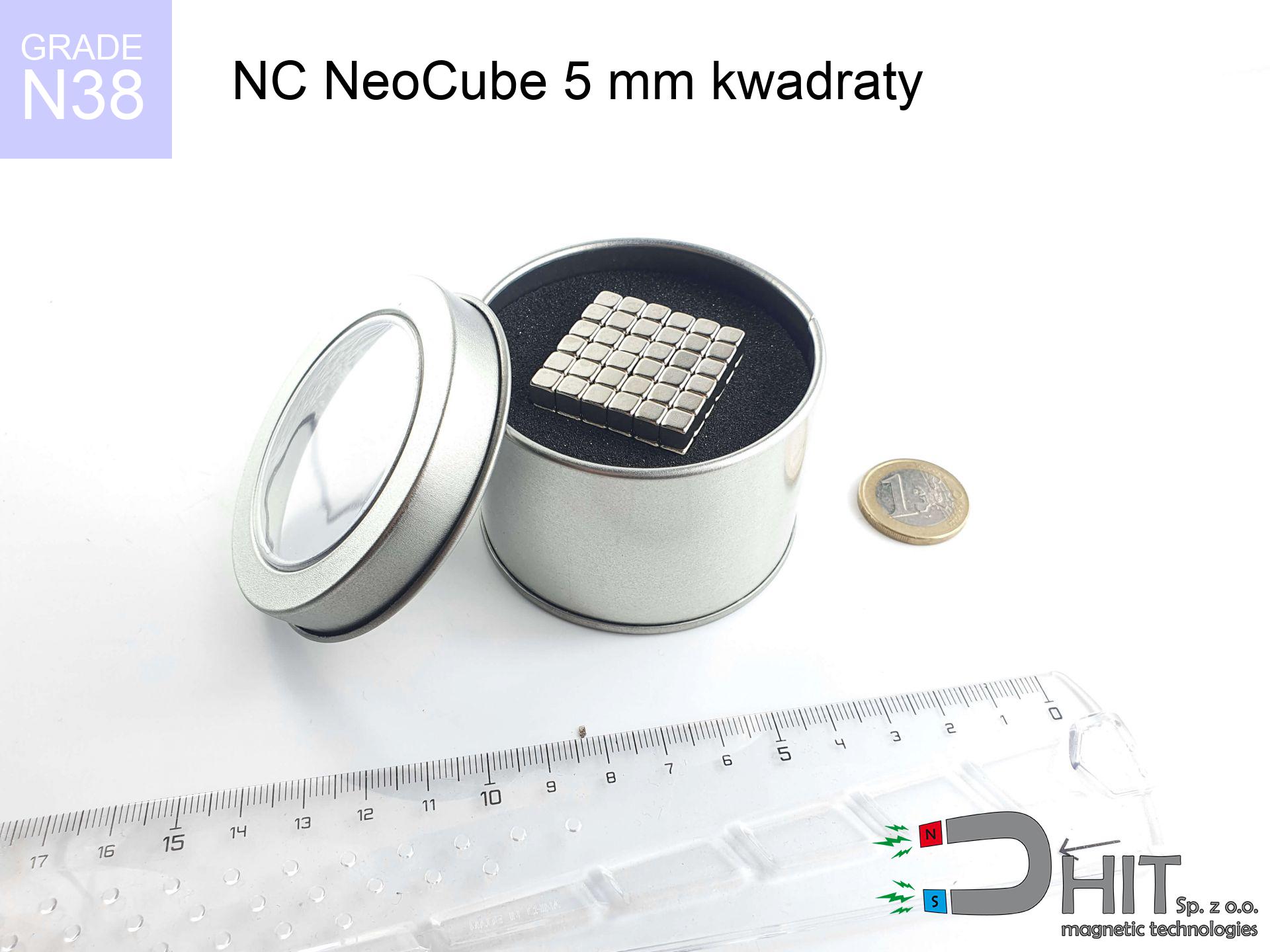
NC NeoCube 5 mm kwadraty / N38 - neocube
neocube
Catalog no 120227
GTIN/EAN: 5906301812661
- Weight
- 216.5 g
- Magnetization Direction
- ↑ axial
- Coating
- [NiCuNi] Nickel
How we measure these parameters — certificates and measurements
40.64 zł net / pcs
49.99 zł with VAT (23% VAT) / pcs
bulk discounts:
Need more?Frequently asked questions
Are magnets in educational construction sets safe for children?
Which NeoCube set is the most durable?
How can I distinguish an original NeoCube set from a poor-quality substitute?
Guides from the knowledge base
Call us now
+48 888 99 98 98
alternatively let us know using
contact form
the contact section.
Specifications and structure of a neodymium magnet can be estimated using our
power calculator.
Order by 14:00 and we’ll ship today!
Physical properties - NC NeoCube 5 mm kwadraty / N38 - neocube
Specification / characteristics - NC NeoCube 5 mm kwadraty / N38 - neocube
| properties | values |
|---|---|
| Cat. no. | 120227 |
| GTIN/EAN | 5906301812661 |
| Production/Distribution | Dhit sp. z o.o. |
| Country of origin | Poland / China / Germany |
| Customs code | 85059029 |
| Weight | 216.5 g |
| Magnetization Direction | ↑ axial |
| Coating | [NiCuNi] Nickel |
| Manufacturing Tolerance | ±1 mm |
Magnetic properties of material N38
| properties | values | units |
|---|---|---|
| Remanence Br ? | 12.2-12.6 | kGs |
| Remanence Br ? | 1220-1260 | mT |
| Coercivity bHc ? | 10.8-11.5 | kOe |
| Coercivity bHc ? | 860-915 | kA/m |
| Intrinsic coercivity iHc | ≥ 12 | kOe |
| Intrinsic coercivity iHc | ≥ 955 | kA/m |
| Energy product BHmax ? | 36-38 | BH max MGOe |
| Energy product BHmax ? | 287-303 | BH max KJ/m |
| Maximum working temperature ? | ≤ 80 | °C |
Physical properties of sintered neodymium magnets Nd2Fe14B at 20°C
| properties | values | units |
|---|---|---|
| Vickers hardness | ≥550 | Hv |
| Density | ≥7.4 | g/cm3 |
| Curie Temperature TC | 310 | °C |
| Curie Temperature TF | 590 | °F |
| Specific resistance | 150 | μΩ⋅cm |
| Bending strength | 250 | MPa |
| Compressive strength | 1000~1100 | MPa |
| Thermal expansion parallel (∥) to orientation (M) | (3-4) x 10-6 | °C-1 |
| Thermal expansion perpendicular (⊥) to orientation (M) | -(1-3) x 10-6 | °C-1 |
| Young's modulus | 1.7 x 10⁴ | kg/mm² |
Material specification
| iron (Fe) | 64% – 68% |
| neodymium (Nd) | 29% – 32% |
| boron (B) | 1.1% – 1.2% |
| dysprosium (Dy) | 0.5% – 2.0% |
| coating (Ni-Cu-Ni) | < 0.05% |
Environmental data
| recyclability (EoL) | 100% |
| recycled raw materials | ~10% (pre-cons) |
| carbon footprint | low / zredukowany |
| waste code (EWC) | 16 02 16 |
Check out more deals
![SM 25x375 [2xM8] / N42 - magnetic separator](https://cdn3.dhit.pl/graphics/products/sm-25x375-2xm8-feg.jpg "SM 25x375 [2xM8] / N42 - magnetic separator")
Strengths and weaknesses of rare earth magnets.
Advantages
- They have constant strength, and over more than ten years their attraction force decreases symbolically – ~1% (according to theory),
- Neodymium magnets prove to be extremely resistant to magnetic field loss caused by external field sources,
- A magnet with a smooth gold surface looks better,
- Neodymium magnets generate maximum magnetic induction on a small surface, which allows for strong attraction,
- Neodymium magnets are characterized by extremely high magnetic induction on the magnet surface and can function (depending on the form) even at a temperature of 230°C or more...
- Possibility of exact modeling and adjusting to precise needs,
- Huge importance in electronics industry – they serve a role in data components, electromotive mechanisms, diagnostic systems, as well as industrial machines.
- Relatively small size with high pulling force – neodymium magnets offer high power in tiny dimensions, which makes them useful in small systems
Limitations
- At very strong impacts they can crack, therefore we advise placing them in steel cases. A metal housing provides additional protection against damage and increases the magnet's durability.
- Do not exceed this material temperature limit: 80°C. Overheating may permanently weaken the magnet.
- Due to the susceptibility of magnets to corrosion in a humid environment, we suggest using waterproof magnets made of rubber, plastic or other material stable to moisture, in case of application outdoors
- We suggest casing - magnetic mechanism, due to difficulties in creating threads inside the magnet and complicated shapes.
- Possible danger resulting from small fragments of magnets can be dangerous, when accidentally swallowed, which gains importance in the context of child health protection. Additionally, small components of these products are able to be problematic in diagnostics medical after entering the body.
- Due to neodymium price, their price is higher than average,
Holding force characteristics
Optimal lifting capacity of a neodymium magnet – what affects it?
- on a plate made of structural steel, perfectly concentrating the magnetic field
- with a thickness minimum 10 mm
- characterized by lack of roughness
- with direct contact (without coatings)
- for force acting at a right angle (in the magnet axis)
- at temperature room level
Practical aspects of lifting capacity – factors
- Gap between magnet and steel – even a fraction of a millimeter of distance (caused e.g. by veneer or unevenness) significantly weakens the magnet efficiency, often by half at just 0.5 mm.
- Loading method – declared lifting capacity refers to detachment vertically. When slipping, the magnet exhibits much less (typically approx. 20-30% of nominal force).
- Metal thickness – the thinner the sheet, the weaker the hold. Part of the magnetic field penetrates through instead of generating force.
- Steel grade – the best choice is high-permeability steel. Stainless steels may attract less.
- Surface structure – the smoother and more polished the plate, the better the adhesion and higher the lifting capacity. Roughness creates an air distance.
- Temperature – temperature increase results in weakening of force. It is worth remembering the maximum operating temperature for a given model.
Holding force was measured on a smooth steel plate of 20 mm thickness, when the force acted perpendicularly, however under attempts to slide the magnet the load capacity is reduced by as much as fivefold. Additionally, even a slight gap between the magnet’s surface and the plate reduces the load capacity.
Precautions when working with NdFeB magnets
Pacemakers
People with a heart stimulator must keep an absolute distance from magnets. The magnetic field can disrupt the functioning of the implant.
Magnets are brittle
Beware of splinters. Magnets can fracture upon violent connection, launching sharp fragments into the air. Eye protection is mandatory.
Adults only
Product intended for adults. Tiny parts can be swallowed, causing severe trauma. Store away from children and animals.
Permanent damage
Watch the temperature. Exposing the magnet above 80 degrees Celsius will permanently weaken its magnetic structure and pulling force.
Precision electronics
A powerful magnetic field disrupts the functioning of magnetometers in phones and GPS navigation. Maintain magnets near a device to prevent breaking the sensors.
Do not drill into magnets
Drilling and cutting of NdFeB material poses a fire risk. Neodymium dust oxidizes rapidly with oxygen and is difficult to extinguish.
Respect the power
Use magnets consciously. Their huge power can shock even experienced users. Stay alert and do not underestimate their power.
Threat to electronics
Intense magnetic fields can erase data on credit cards, hard drives, and storage devices. Stay away of at least 10 cm.
Allergic reactions
Nickel alert: The Ni-Cu-Ni coating contains nickel. If skin irritation happens, immediately stop handling magnets and wear gloves.
Hand protection
Risk of injury: The attraction force is so great that it can cause blood blisters, crushing, and broken bones. Use thick gloves.
Tabela kosztu i czasu dostawy
Płatność przed wysyłką:

GLS kurier
Przesyłka będzie u Ciebie za 2-3 dni
14.99 ZŁ

InPost Paczkomaty 24/7
Przesyłka będzie u Ciebie za 1-2 dni
12.30 ZŁ
Płatność przy odbiorze (pobranie):
GLS kurier
Przesyłka będzie u Ciebie za 1-2 dni
23.00 ZŁ