
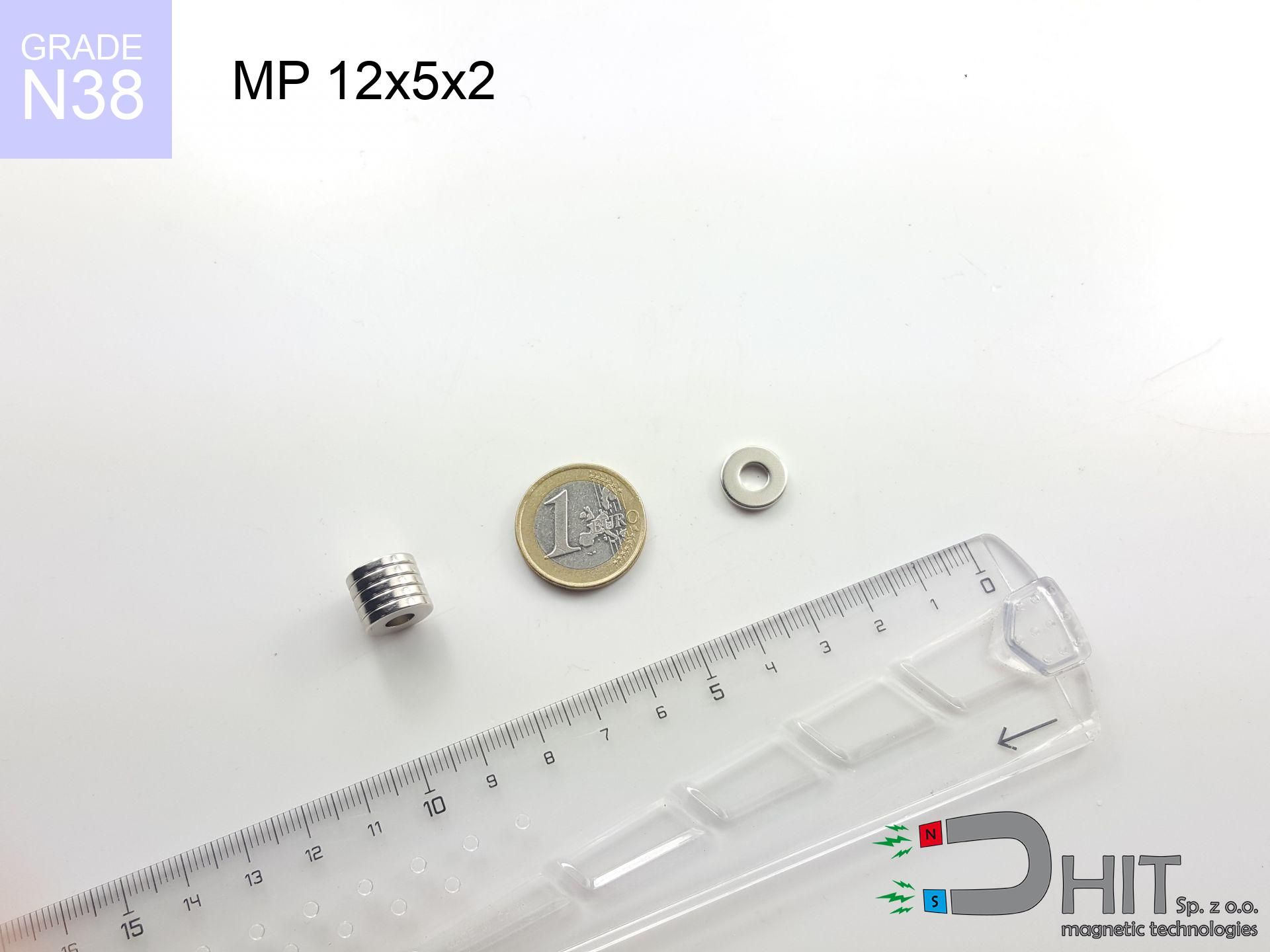
MP 12x5x2 / N38 - ring magnet
ring magnet
Catalog no 030498
Diameter
12 mm [±0,1 mm]
internal diameter Ø
5 mm [±0,1 mm]
Height
2 mm [±0,1 mm]
Weight
1.4 g
Magnetization Direction
↑ axial
Load capacity
1.15 kg / 11.29 N
Magnetic Induction
195.97 mT / 1960 Gs
Coating
[NiCuNi] Nickel
1.230 ZŁ with VAT / pcs + price for transport
1.000 ZŁ net + 23% VAT / pcs
bulk discounts:
Need more?
Call us now
+48 888 99 98 98
or let us know using
our online form
the contact form page.
Parameters as well as form of magnetic components can be analyzed using our
online calculation tool.
Orders placed before 14:00 will be shipped the same business day.
Technical data of the product - MP 12x5x2 / N38 - ring magnet
Specification / characteristics - MP 12x5x2 / N38 - ring magnet
| properties | values |
|---|---|
| Cat. no. | 030498 |
| Production/Distribution | Dhit sp. z o.o. |
| Country of origin | Poland / China / Germany |
| Customs code | 85059029 |
| Diameter | 12 mm [±0,1 mm] |
| internal diameter Ø | 5 mm [±0,1 mm] |
| Height | 2 mm [±0,1 mm] |
| Weight | 1.4 g |
| Magnetization Direction | ↑ axial |
| Load capacity ~ ? | 1.15 kg / 11.29 N |
| Magnetic Induction ~ ? | 195.97 mT / 1960 Gs |
| Coating | [NiCuNi] Nickel |
| Manufacturing Tolerance | ±0.1 mm |
Magnetic properties of material N38
| properties | values | units |
|---|---|---|
| remenance Br [min. - max.] ? | 12.2-12.6 | kGs |
| remenance Br [min. - max.] ? | 1220-1260 | mT |
| coercivity bHc ? | 10.8-11.5 | kOe |
| coercivity bHc ? | 860-915 | kA/m |
| actual internal force iHc | ≥ 12 | kOe |
| actual internal force iHc | ≥ 955 | kA/m |
| energy density [min. - max.] ? | 36-38 | BH max MGOe |
| energy density [min. - max.] ? | 287-303 | BH max KJ/m |
| max. temperature ? | ≤ 80 | °C |
Physical properties of sintered neodymium magnets Nd2Fe14B at 20°C
| properties | values | units |
|---|---|---|
| Vickers hardness | ≥550 | Hv |
| Density | ≥7.4 | g/cm3 |
| Curie Temperature TC | 312 - 380 | °C |
| Curie Temperature TF | 593 - 716 | °F |
| Specific resistance | 150 | μΩ⋅cm |
| Bending strength | 250 | MPa |
| Compressive strength | 1000~1100 | MPa |
| Thermal expansion parallel (∥) to orientation (M) | (3-4) x 10-6 | °C-1 |
| Thermal expansion perpendicular (⊥) to orientation (M) | -(1-3) x 10-6 | °C-1 |
| Young's modulus | 1.7 x 10⁴ | kg/mm² |
Technical simulation of the assembly - data
Presented data represent the result of a mathematical calculation. Results rely on algorithms for the material Nd2Fe14B. Real-world parameters may deviate from the simulation results. Please consider these calculations as a reference point when designing systems.
Table 1: Static pull force (pull vs gap) - interaction chart
MP 12x5x2 / N38
| Distance (mm) | Induction (Gauss) / mT | Pull Force (kg/lbs/g/N) | Risk Status |
|---|---|---|---|
| 0 mm |
6085 Gs
608.5 mT
|
1.15 kg / 2.54 pounds
1150.0 g / 11.3 N
|
safe |
| 1 mm |
5082 Gs
508.2 mT
|
0.80 kg / 1.77 pounds
802.2 g / 7.9 N
|
safe |
| 2 mm |
4147 Gs
414.7 mT
|
0.53 kg / 1.18 pounds
534.0 g / 5.2 N
|
safe |
| 3 mm |
3340 Gs
334.0 mT
|
0.35 kg / 0.76 pounds
346.3 g / 3.4 N
|
safe |
| 5 mm |
2152 Gs
215.2 mT
|
0.14 kg / 0.32 pounds
143.8 g / 1.4 N
|
safe |
| 10 mm |
822 Gs
82.2 mT
|
0.02 kg / 0.05 pounds
21.0 g / 0.2 N
|
safe |
| 15 mm |
394 Gs
39.4 mT
|
0.00 kg / 0.01 pounds
4.8 g / 0.0 N
|
safe |
| 20 mm |
221 Gs
22.1 mT
|
0.00 kg / 0.00 pounds
1.5 g / 0.0 N
|
safe |
| 30 mm |
92 Gs
9.2 mT
|
0.00 kg / 0.00 pounds
0.3 g / 0.0 N
|
safe |
| 50 mm |
28 Gs
2.8 mT
|
0.00 kg / 0.00 pounds
0.0 g / 0.0 N
|
safe |
Table 2: Shear force (vertical surface)
MP 12x5x2 / N38
| Distance (mm) | Friction coefficient | Pull Force (kg/lbs/g/N) |
|---|---|---|
| 0 mm | Stal (~0.2) |
0.23 kg / 0.51 pounds
230.0 g / 2.3 N
|
| 1 mm | Stal (~0.2) |
0.16 kg / 0.35 pounds
160.0 g / 1.6 N
|
| 2 mm | Stal (~0.2) |
0.11 kg / 0.23 pounds
106.0 g / 1.0 N
|
| 3 mm | Stal (~0.2) |
0.07 kg / 0.15 pounds
70.0 g / 0.7 N
|
| 5 mm | Stal (~0.2) |
0.03 kg / 0.06 pounds
28.0 g / 0.3 N
|
| 10 mm | Stal (~0.2) |
0.00 kg / 0.01 pounds
4.0 g / 0.0 N
|
| 15 mm | Stal (~0.2) |
0.00 kg / 0.00 pounds
0.0 g / 0.0 N
|
| 20 mm | Stal (~0.2) |
0.00 kg / 0.00 pounds
0.0 g / 0.0 N
|
| 30 mm | Stal (~0.2) |
0.00 kg / 0.00 pounds
0.0 g / 0.0 N
|
| 50 mm | Stal (~0.2) |
0.00 kg / 0.00 pounds
0.0 g / 0.0 N
|
Table 3: Wall mounting (shearing) - behavior on slippery surfaces
MP 12x5x2 / N38
| Surface type | Friction coefficient / % Mocy | Max load (kg/lbs/g/N) |
|---|---|---|
| Raw steel |
µ = 0.3
30% Nominalnej Siły
|
0.35 kg / 0.76 pounds
345.0 g / 3.4 N
|
| Painted steel (standard) |
µ = 0.2
20% Nominalnej Siły
|
0.23 kg / 0.51 pounds
230.0 g / 2.3 N
|
| Oily/slippery steel |
µ = 0.1
10% Nominalnej Siły
|
0.11 kg / 0.25 pounds
115.0 g / 1.1 N
|
| Magnet with anti-slip rubber |
µ = 0.5
50% Nominalnej Siły
|
0.58 kg / 1.27 pounds
575.0 g / 5.6 N
|
Table 4: Material efficiency (saturation) - power losses
MP 12x5x2 / N38
| Steel thickness (mm) | % power | Real pull force (kg/lbs/g/N) |
|---|---|---|
| 0.5 mm |
|
0.11 kg / 0.25 pounds
115.0 g / 1.1 N
|
| 1 mm |
|
0.29 kg / 0.63 pounds
287.5 g / 2.8 N
|
| 2 mm |
|
0.58 kg / 1.27 pounds
575.0 g / 5.6 N
|
| 3 mm |
|
0.86 kg / 1.90 pounds
862.5 g / 8.5 N
|
| 5 mm |
|
1.15 kg / 2.54 pounds
1150.0 g / 11.3 N
|
| 10 mm |
|
1.15 kg / 2.54 pounds
1150.0 g / 11.3 N
|
| 11 mm |
|
1.15 kg / 2.54 pounds
1150.0 g / 11.3 N
|
| 12 mm |
|
1.15 kg / 2.54 pounds
1150.0 g / 11.3 N
|
Table 5: Thermal stability (stability) - thermal limit
MP 12x5x2 / N38
| Ambient temp. (°C) | Power loss | Remaining pull (kg/lbs/g/N) | Status |
|---|---|---|---|
| 20 °C | 0.0% |
1.15 kg / 2.54 pounds
1150.0 g / 11.3 N
|
OK |
| 40 °C | -2.2% |
1.12 kg / 2.48 pounds
1124.7 g / 11.0 N
|
OK |
| 60 °C | -4.4% |
1.10 kg / 2.42 pounds
1099.4 g / 10.8 N
|
OK |
| 80 °C | -6.6% |
1.07 kg / 2.37 pounds
1074.1 g / 10.5 N
|
|
| 100 °C | -28.8% |
0.82 kg / 1.81 pounds
818.8 g / 8.0 N
|
Table 6: Two magnets (repulsion) - forces in the system
MP 12x5x2 / N38
| Gap (mm) | Attraction (kg/lbs) (N-S) | Shear Strength (kg/lbs/g/N) | Repulsion (kg/lbs) (N-N) |
|---|---|---|---|
| 0 mm |
21.34 kg / 47.04 pounds
6 163 Gs
|
3.20 kg / 7.06 pounds
3201 g / 31.4 N
|
N/A |
| 1 mm |
17.97 kg / 39.61 pounds
11 168 Gs
|
2.69 kg / 5.94 pounds
2695 g / 26.4 N
|
16.17 kg / 35.65 pounds
~0 Gs
|
| 2 mm |
14.88 kg / 32.81 pounds
10 165 Gs
|
2.23 kg / 4.92 pounds
2233 g / 21.9 N
|
13.40 kg / 29.53 pounds
~0 Gs
|
| 3 mm |
12.20 kg / 26.89 pounds
9 202 Gs
|
1.83 kg / 4.03 pounds
1830 g / 17.9 N
|
10.98 kg / 24.20 pounds
~0 Gs
|
| 5 mm |
8.00 kg / 17.63 pounds
7 450 Gs
|
1.20 kg / 2.64 pounds
1199 g / 11.8 N
|
7.20 kg / 15.87 pounds
~0 Gs
|
| 10 mm |
2.67 kg / 5.88 pounds
4 304 Gs
|
0.40 kg / 0.88 pounds
400 g / 3.9 N
|
2.40 kg / 5.30 pounds
~0 Gs
|
| 20 mm |
0.39 kg / 0.86 pounds
1 644 Gs
|
0.06 kg / 0.13 pounds
58 g / 0.6 N
|
0.35 kg / 0.77 pounds
~0 Gs
|
| 50 mm |
0.01 kg / 0.02 pounds
275 Gs
|
0.00 kg / 0.00 pounds
2 g / 0.0 N
|
0.01 kg / 0.02 pounds
~0 Gs
|
| 60 mm |
0.00 kg / 0.01 pounds
184 Gs
|
0.00 kg / 0.00 pounds
1 g / 0.0 N
|
0.00 kg / 0.00 pounds
~0 Gs
|
| 70 mm |
0.00 kg / 0.01 pounds
129 Gs
|
0.00 kg / 0.00 pounds
0 g / 0.0 N
|
0.00 kg / 0.00 pounds
~0 Gs
|
| 80 mm |
0.00 kg / 0.00 pounds
95 Gs
|
0.00 kg / 0.00 pounds
0 g / 0.0 N
|
0.00 kg / 0.00 pounds
~0 Gs
|
| 90 mm |
0.00 kg / 0.00 pounds
72 Gs
|
0.00 kg / 0.00 pounds
0 g / 0.0 N
|
0.00 kg / 0.00 pounds
~0 Gs
|
| 100 mm |
0.00 kg / 0.00 pounds
56 Gs
|
0.00 kg / 0.00 pounds
0 g / 0.0 N
|
0.00 kg / 0.00 pounds
~0 Gs
|
Table 7: Hazards (implants) - warnings
MP 12x5x2 / N38
| Object / Device | Limit (Gauss) / mT | Safe distance |
|---|---|---|
| Pacemaker | 5 Gs (0.5 mT) | 10.0 cm |
| Hearing aid | 10 Gs (1.0 mT) | 8.0 cm |
| Mechanical watch | 20 Gs (2.0 mT) | 6.0 cm |
| Phone / Smartphone | 40 Gs (4.0 mT) | 4.5 cm |
| Car key | 50 Gs (5.0 mT) | 4.0 cm |
| Payment card | 400 Gs (40.0 mT) | 1.5 cm |
| HDD hard drive | 600 Gs (60.0 mT) | 1.5 cm |
Table 8: Impact energy (kinetic energy) - warning
MP 12x5x2 / N38
| Start from (mm) | Speed (km/h) | Energy (J) | Predicted outcome |
|---|---|---|---|
| 10 mm |
29.23 km/h
(8.12 m/s)
|
0.05 J | |
| 30 mm |
50.07 km/h
(13.91 m/s)
|
0.14 J | |
| 50 mm |
64.63 km/h
(17.95 m/s)
|
0.23 J | |
| 100 mm |
91.40 km/h
(25.39 m/s)
|
0.45 J |
Table 9: Corrosion resistance
MP 12x5x2 / N38
| Technical parameter | Value / Description |
|---|---|
| Coating type | [NiCuNi] Nickel |
| Layer structure | Nickel - Copper - Nickel |
| Layer thickness | 10-20 µm |
| Salt spray test (SST) ? | 24 h |
| Recommended environment | Indoors only (dry) |
Table 10: Electrical data (Pc)
MP 12x5x2 / N38
| Parameter | Value | SI Unit / Description |
|---|---|---|
| Magnetic Flux | 6 503 Mx | 65.0 µWb |
| Pc Coefficient | 1.34 | High (Stable) |
Table 11: Underwater work (magnet fishing)
MP 12x5x2 / N38
| Environment | Effective steel pull | Effect |
|---|---|---|
| Air (land) | 1.15 kg | Standard |
| Water (riverbed) |
1.32 kg
(+0.17 kg buoyancy gain)
|
+14.5% |
1. Shear force
*Note: On a vertical surface, the magnet holds just approx. 20-30% of its max power.
2. Efficiency vs thickness
*Thin metal sheet (e.g. 0.5mm PC case) severely limits the holding force.
3. Temperature resistance
*For N38 material, the critical limit is 80°C.
4. Demagnetization curve and operating point (B-H)
chart generated for the permeance coefficient Pc (Permeance Coefficient) = 1.34
This simulation demonstrates the magnetic stability of the selected magnet under specific geometric conditions. The solid red line represents the demagnetization curve (material potential), while the dashed blue line is the load line based on the magnet's geometry. The Pc (Permeance Coefficient), also known as the load line slope, is a dimensionless value that describes the relationship between the magnet's shape and its magnetic stability. The intersection of these two lines (the black dot) is the operating point — it determines the actual magnetic flux density generated by the magnet in this specific configuration. A higher Pc value means the magnet is more 'slender' (tall relative to its area), resulting in a higher operating point and better resistance to irreversible demagnetization caused by external fields or temperature. A value of 0.42 is relatively low (typical for flat magnets), meaning the operating point is closer to the 'knee' of the curve — caution is advised when operating at temperatures near the maximum limit to avoid strength loss.
Material specification
| iron (Fe) | 64% – 68% |
| neodymium (Nd) | 29% – 32% |
| boron (B) | 1.1% – 1.2% |
| dysprosium (Dy) | 0.5% – 2.0% |
| coating (Ni-Cu-Ni) | < 0.05% |
Environmental data
| recyclability (EoL) | 100% |
| recycled raw materials | ~10% (pre-cons) |
| carbon footprint | low / zredukowany |
| waste code (EWC) | 16 02 16 |
View more proposals

![UMH 36x8x46 [M6] / N38 - magnetic holder with hook](https://cdn3.dhit.pl/graphics/products/umh-36x8x46-m6-wim.jpg "UMH 36x8x46 [M6] / N38 - magnetic holder with hook")
![UMH 60x15x69 [M8] / N38 - magnetic holder with hook](https://cdn3.dhit.pl/graphics/products/umh-60x15x69-m8-nij.jpg "UMH 60x15x69 [M8] / N38 - magnetic holder with hook")
![SM 32x350 [2xM8] / N42 - magnetic separator](https://cdn3.dhit.pl/graphics/products/sm-32x350-2xm8-nih.jpg "SM 32x350 [2xM8] / N42 - magnetic separator")
Strengths as well as weaknesses of Nd2Fe14B magnets.
Advantages
- They retain full power for nearly ten years – the drop is just ~1% (in theory),
- They possess excellent resistance to magnetism drop as a result of opposing magnetic fields,
- A magnet with a shiny silver surface is more attractive,
- The surface of neodymium magnets generates a powerful magnetic field – this is a key feature,
- Due to their durability and thermal resistance, neodymium magnets are capable of operate (depending on the shape) even at high temperatures reaching 230°C or more...
- In view of the ability of accurate forming and customization to custom requirements, neodymium magnets can be produced in a broad palette of forms and dimensions, which makes them more universal,
- Fundamental importance in high-tech industry – they serve a role in mass storage devices, electric drive systems, medical equipment, also technologically advanced constructions.
- Relatively small size with high pulling force – neodymium magnets offer high power in tiny dimensions, which allows their use in small systems
Weaknesses
- At very strong impacts they can break, therefore we advise placing them in special holders. A metal housing provides additional protection against damage, as well as increases the magnet's durability.
- Neodymium magnets demagnetize when exposed to high temperatures. After reaching 80°C, many of them experience permanent drop of strength (a factor is the shape and dimensions of the magnet). We offer magnets specially adapted to work at temperatures up to 230°C marked [AH], which are extremely resistant to heat
- When exposed to humidity, magnets start to rust. For applications outside, it is recommended to use protective magnets, such as magnets in rubber or plastics, which secure oxidation as well as corrosion.
- We suggest a housing - magnetic mechanism, due to difficulties in creating nuts inside the magnet and complex forms.
- Health risk to health – tiny shards of magnets are risky, in case of ingestion, which gains importance in the aspect of protecting the youngest. Furthermore, small components of these products can complicate diagnosis medical when they are in the body.
- High unit price – neodymium magnets have a higher price than other types of magnets (e.g. ferrite), which hinders application in large quantities
Pull force analysis
Best holding force of the magnet in ideal parameters – what it depends on?
- using a plate made of mild steel, acting as a circuit closing element
- possessing a thickness of at least 10 mm to avoid saturation
- with a plane perfectly flat
- with zero gap (without coatings)
- for force applied at a right angle (in the magnet axis)
- at temperature approx. 20 degrees Celsius
Determinants of practical lifting force of a magnet
- Clearance – the presence of foreign body (paint, tape, air) acts as an insulator, which reduces capacity steeply (even by 50% at 0.5 mm).
- Angle of force application – highest force is reached only during pulling at a 90° angle. The force required to slide of the magnet along the surface is standardly many times smaller (approx. 1/5 of the lifting capacity).
- Base massiveness – insufficiently thick steel does not close the flux, causing part of the flux to be escaped to the other side.
- Material composition – not every steel reacts the same. Alloy additives weaken the interaction with the magnet.
- Surface condition – smooth surfaces ensure maximum contact, which increases field saturation. Rough surfaces reduce efficiency.
- Heat – NdFeB sinters have a sensitivity to temperature. When it is hot they are weaker, and at low temperatures gain strength (up to a certain limit).
Lifting capacity was determined with the use of a steel plate with a smooth surface of optimal thickness (min. 20 mm), under vertically applied force, whereas under parallel forces the load capacity is reduced by as much as fivefold. In addition, even a slight gap between the magnet and the plate decreases the holding force.
H&S for magnets
Thermal limits
Do not overheat. NdFeB magnets are susceptible to temperature. If you need operation above 80°C, ask us about special high-temperature series (H, SH, UH).
Respect the power
Before starting, read the rules. Sudden snapping can destroy the magnet or hurt your hand. Think ahead.
Protect data
Intense magnetic fields can erase data on payment cards, HDDs, and storage devices. Stay away of min. 10 cm.
Physical harm
Large magnets can crush fingers instantly. Never place your hand betwixt two attracting surfaces.
No play value
Neodymium magnets are not toys. Swallowing several magnets may result in them attracting across intestines, which poses a direct threat to life and requires urgent medical intervention.
Combustion hazard
Powder generated during machining of magnets is flammable. Avoid drilling into magnets unless you are an expert.
Keep away from electronics
An intense magnetic field disrupts the operation of compasses in smartphones and navigation systems. Maintain magnets close to a smartphone to avoid damaging the sensors.
Medical implants
People with a heart stimulator should keep an safe separation from magnets. The magnetism can interfere with the functioning of the implant.
Fragile material
Despite the nickel coating, neodymium is delicate and cannot withstand shocks. Avoid impacts, as the magnet may crumble into hazardous fragments.
Skin irritation risks
Studies show that the nickel plating (the usual finish) is a common allergen. If you have an allergy, prevent touching magnets with bare hands or select versions in plastic housing.
Tabela kosztu i czasu dostawy
Płatność przed wysyłką:

GLS kurier
Przesyłka będzie u Ciebie za 2-3 dni
14.99 ZŁ

InPost Paczkomaty 24/7
Przesyłka będzie u Ciebie za 1-2 dni
12.30 ZŁ
Płatność przy odbiorze (pobranie):
GLS kurier
Przesyłka będzie u Ciebie za 1-2 dni
23.00 ZŁ
Rate the product

Your rating