

Earth magnetism - Earth as a giant magnet
Earth's magnetic field and its key role
Earth's magnetic field and its key role
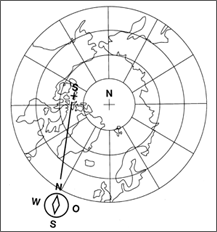
Earth possesses a remarkable magnetic field that plays a key role in protecting our planet. It consists of north and south poles, where the geographic north pole aligns with the magnetic north pole, and the geographic south pole with the magnetic south pole. Eddy currents within Earth's interior cause the magnetic poles to constantly change their position.
The magnetic south pole is currently located in northern Canada, about 1000 km from the geographic north pole. A compass needle indicates direction with a deviation called magnetic declination, which in Poland is currently 2.5°. Studies have shown that the magnetic south pole shifted by over 190 km in just five years between 1995 and 2000.
Analyses of volcanic rocks revealed that Earth's magnetic field has repeatedly reversed its polarity. The strength of this field varies by location and is strongest at the poles. It can be weakened by the presence of metals such as nickel, iron, and cobalt in the Earth's crust. Despite this, Earth's magnetic field is much weaker than the field of permanent magnets, such as neodymium magnets (NdFeB) or samarium-cobalt magnets (SmCo).
The process of field generation, called geodynamics, relies on the movement of molten iron in Earth's outer core. these movements generate electric currents, which in turn produce the magnetic field. For this process to be possible, a planet must have rapid rotation, a fluid conductive interior, and an energy source driving convection currents.
Understanding the Earth's magnetic field is of key importance for science and technology, from navigation to protecting infrastructure against geomagnetic storms.
How does Earth's magnetic field protect our planet?
The Magnetosphere, surrounding Earth, acts as a protective shield, deflecting harmful solar wind particles and cosmic radiation. This protects Earth's atmosphere from erosion and allows life to sustain.
However, the magnetosphere is not invincible. Strong geomagnetic storms, caused by solar activity, can disrupt satellites, navigation systems, and radio communications. An example is the geomagnetic storm of 1859, known as the Carrington Event, which caused global telegraph system failures.
Phenomena related to Earth's magnetic field
Earth's magnetic field generates many extraordinary phenomena. Auroras (Northern and Southern Lights), caused by the interaction of solar wind particles with the atmosphere, are among the most spectacular effects of the magnetosphere. The magnetic field also influences animal navigation and migration.
Geological studies show that the magnetic field has reversed its polarity multiple times in the past, impacting climate and geological processes. Understanding these mechanisms is crucial for future forecasts and the development of technologies that can utilize the potential of magnetism.

earth magnetism
Magnetic flux lines of the geomagnetic field run from the Earth's surface at various angles relative to the polar axis, creating unique patterns. These lines resemble the arrangement of force lines around permanent magnets (bar magnets), although their scale and impact on life are vastly greater. Magnetic flux influences spectacular phenomena such as auroras, visible in polar regions.
Magnetism has fascinated people for millennia. Compasses used since the 13th century were one of the first practical applications of Earth's magnetic field, enabling geographical discoveries. Today, the magnetic field inspires the creation of advanced technologies, such as magnetic railways or navigation systems. Understanding Earth's magnetic field also allows for the development of new materials and technologies that matter in industry, communication, and daily life.

(magnetic field sensor, i.e., compass)
The compass follows the lines of magnetic flux.

repels

repels

attracts

attracts